
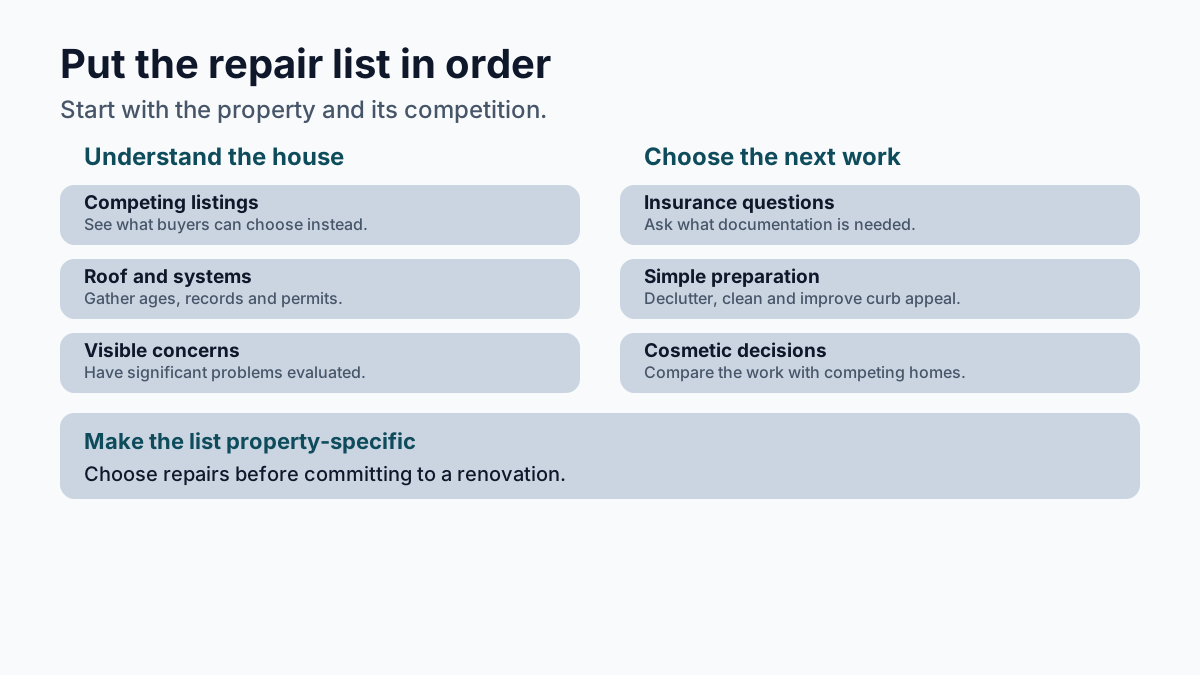
Start with the homes competing against yours right now, because they set what a buyer expects. Then fix what an inspector and an insurer will look at: the roof and its paperwork, then the HVAC, water heater, electrical, and plumbing, then deferred maintenance visible from the driveway. Cosmetics come last. Near the ocean, two of those items also shape what a buyer's insurance will cost.
The temptation is to work that list from the bottom up.
Picture a seller who paints, replaces the carpet, and stages the living room. The photographs come out beautifully. Then the inspection report raises questions about an older roof, and the conversation turns to shingles instead of the porch they just had rescreened.
The paint wasn't wasted. It was early.
How do you decide what to fix before selling a house?
Tour the homes competing with yours right now, and let what they've already handled tell you what yours still needs. A sale that closed last spring tells you what someone paid under conditions that have already changed.
The house two streets over that a buyer will tour the same Saturday as yours tells you what you're up against.
Go see those houses in person, in the price band you're aiming at, and note what has already been handled.
- If three of them have new roofs, yours needs an answer.
- If none of them have touched their kitchens, yours probably doesn't need one either.
- If they all show well inside, your advantage may be the lot, the elevation, or the garage nobody else has.
The competition sets the standard, and the standard isn't the same in the historic downtown blocks as it is in a 1990s subdivision out toward Yulee.
What should you fix first when selling a house?
The roof is the item a buyer can't unsee, and in Florida it also deserves an early conversation with the buyer's insurer.
If yours is around twenty years old, it needs a documented plan rather than a shrug. Replace it and account for the work in your pricing, or understand in advance how a replacement request would be handled before closing. Either answer works. Having no answer is the expensive option.
Then gather the paper for everything else:
- the roof permit and its final inspection
- the HVAC install date and any service records
- the water heater's age
- panel upgrades or rewiring
- repipe records, if the house has been repiped
- the flood zone determination and any elevation certificate
One walk outside is worth taking before you list. Check the outdoor condenser and its base for visible rust, and have any concern evaluated before a buyer's inspection. Photographs travel further than explanations do.
What will a buyer's inspector actually check?
A buyer's inspection covers the home's major systems, subject to access and the inspection's scope. Inspectors working to the American Society of Home Inspectors' standard of practice examine the structure and foundation, the roof, plumbing, electrical, heating, and air conditioning.
That list is your pre-listing checklist, because it's the one a buyer is paying someone to run.
A few things you can settle the week before photos:
- Run every faucet and look under every sink.
- Have faulty outlets or GFCIs checked by a qualified professional.
- Clear access to the attic, the crawl space, and the electrical panel.
- Fix the screen door, the sticking window, and the gate that won't latch, because small broken things read as a pattern.
What do Florida sellers need to know about radon and wind mitigation?
Radon comes with a state disclosure your buyer will read, and wind mitigation comes with insurance discounts that depend on the features being documented. The first is radon, and it shows up whether you invite it or not. State law puts a specific radon gas disclosure notice on a document executed at or before the contract for sale, for any building in the state. It says nothing about your particular house. It is still a form your buyer will read, and readers ask questions.
Make radon testing part of the plan. The EPA's guidance is to test every home no matter where you live, and to fix a home that reads 4 pCi/L or higher. A test is inexpensive. Learning the number in the middle of a buyer's inspection period is not.
The second is wind mitigation. Citizens Property Insurance Corporation, the state-created property insurer, says documented features can qualify a home for premium discounts: impact-rated doors and windows, storm shutters, wind-rated roofing, and roof-to-wall attachments. Ask the insurer what inspection and documents it needs before counting on a credit.
Which cosmetic work actually pays?
My order for cosmetic work is decluttering, cleaning, curb appeal, and then staging.
In a February 2025 survey of Realtors (a random sample of 49,806, with 1,266 usable responses and a margin of error of plus or minus 2.75%), the pre-listing work sellers' agents recommended most often was decluttering (91%), cleaning the entire home (88%), and improving curb appeal (77%).
Not one of those is a renovation. They cost weekends more than they cost money.
Staging came next. In the same survey, 29% of sellers' agents said staging raised the dollar value of offers by 1% to 10%, and 49% said it reduced the time a home spent on the market. Buyers’ agents reported the living room as the most important room to stage (37%), then the primary bedroom (34%), then the kitchen (23%).
Those leading recommendations aren't a reason to rule out every renovation. They're a reason to start with the simpler work before you price a kitchen or bathroom overhaul.
You stop seeing your own house after the first few years, which is why an outside opinion on what to remove is usually worth more than an outside opinion on what to buy.
Do you have to fix everything?
No. Start with the work that matters to this property and its competing listings.
A house doesn't have to be finished before it sells. It has to be legible. A buyer who can see the roof's age, the service records, and the permits for work already done is negotiating about a known house. A buyer without that folder is negotiating about a risk, and uncertainty can make negotiation harder.
That judgment is the part worth having a professional for. Anyone can hand you a list of repairs. Deciding which three items on it matter for your street, at your price, in this season, and which four you can leave alone, is the actual work.
When I review a home with a seller, I start with what's competing now, then work through the roof, major systems, documentation and visible deferred maintenance before deciding on cosmetic work.
Cosmetics shape how a house feels in the first minute. Documentation helps a buyer understand what comes next.
If you're thinking about selling this year and you aren't sure which repairs are worth making, I'm happy to walk your home and put the list in order before you spend anything.
Frequently asked questions
What should you not fix before selling a house?
I would not put a full kitchen remodel, bathroom gut, or new flooring on the list without comparing competing homes first. In the February 2025 Realtor survey, the work sellers' agents recommended most often was decluttering (91%), cleaning the entire home (88%), and improving curb appeal (77%), none of which is a renovation. Handle the roof, the major systems, and the visible deferred maintenance first, then pick cosmetics based on what competing listings already show.
Should I replace a twenty-year-old roof before listing, or price for it?
Either works, and having no answer does not. Citizens Property Insurance Corporation, the state-created insurer, says documented features can [qualify a home for premium discounts](https://www.citizensfla.com/wind-mitigation-inspections), including wind-rated roofing and roof-to-wall attachments. Gather the roof permit, its final inspection, and any wind-mitigation report, then ask the buyer's insurer what else it needs for a quote.
What devalues a house the most?
There is no single answer for every house. I would start by reducing uncertainty: gather the roof's age, the service records, and the permits for work already done so the buyer can price known conditions.
What are some red flags when selling?
Start with visible concerns: an older roof with no documented plan, rust at the condenser base, and small broken things like a sticking window or a gate that won't latch. Have significant concerns evaluated and settle the small ones before photos.
Sources reviewed
- Florida Statute 404.056(5) — radon gas disclosure notice text
- EPA — Health Risk of Radon
- Citizens Property Insurance Corporation — Wind Mitigation Inspections
- NAR newsroom — 2025 Profile of Home Staging report (survey methodology)
- ASHI — Standard of Practice (scope of a home inspection)
- EPA Radon: all homes should be tested
- KeyCrew interview with Angie Heitzer — her own account and professional advice