A wind mitigation report is Florida's Uniform Mitigation Verification Inspection Form, OIR-B1-1802. A licensed inspector documents the wind-resistant features of your house, you give it to your insurer, and the insurer has to build discounts for those features into its rates. One form stays good for up to five years.
Plenty of people meet this form at a bad moment. A renewal notice arrives with a number that does not match last year's. Or a buyer's insurance quote comes back in the middle of an inspection period and the deal goes quiet for a day while everyone redoes the math.
It is a better document to meet early, when nothing is riding on it.
What is a wind mitigation report in Florida?
In Florida, a wind mitigation report is one standard form: the Financial Services Commission develops it by rule, and it is the one all insurers use. That matters more than it sounds like it should. A home inspection report reflects the judgment of whoever wrote it. This one is a fixed set of questions, asked the same way in Yulee as on the north end of the island.
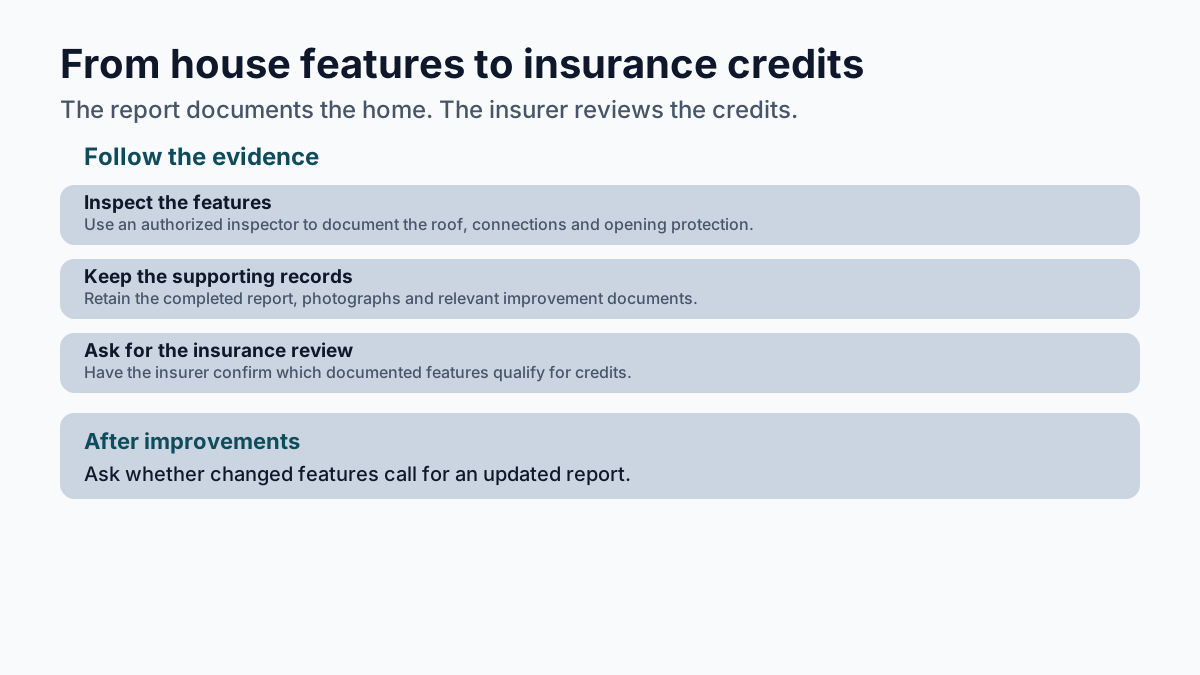
Its reason to exist is the discount. The statute describes the form as what policyholders submit for the purpose of factoring discounts for wind insurance.
Nobody passes or fails it. It records what is there. A house with every wind-resistant feature on the list and a house with none of them get the same form, and the difference shows up in what the carrier does with it.
Are Florida insurers required to give wind mitigation discounts?
Yes, Florida law requires the discount, so it is not goodwill from your carrier. A rate filing for residential property insurance must include actuarially reasonable discounts, credits, or other rate differentials for properties with construction features shown to reduce windstorm losses. The Legislature wrote the point into the same statute: its stated intent is that insurers provide savings to consumers who install or implement windstorm mitigation.
So your carrier is not deciding whether to reward a well-attached roof. It is waiting to be shown one.
What does a wind mitigation report include?
A wind mitigation report records features such as the roof covering, roof deck and roof-to-wall attachments, roof shape, secondary water resistance, and protection at windows and doors. The statute describes a broader set of construction features that the mandated discounts have to cover:
- wind uplift prevention
- roof strength and roof covering performance
- roof-to-wall strength
- wall-to-floor-to-foundation strength
- opening protection, plus window, door and skylight strength
Read that statutory list as a house instead of a statute. It runs from the roof through the connections below it to the openings in the building. The inspection form asks specific questions about those wind-resistant features; it is not a full structural assessment.
Opening protection is the piece homeowners here tend to underestimate. Panels stacked behind the kayaks at the back of the garage do you no good on the morning the inspector walks the house. Have them out where they can be seen and identified. Same for permits and receipts from a re-roof or a window replacement.
An older cottage a few blocks off Centre Street may have had three roofs and two additions since it went up. The form describes the building as it stands today, not as it started, and documents are how the house proves what it has become.
Who can sign a wind mitigation form in Florida?
Authorized signers include a licensed home inspector with at least three hours of approved hurricane mitigation training and a completed proficiency exam, a certified building code inspector, a licensed general, building or residential contractor, a professional engineer, or a professional architect. The law also allows other individuals or entities the insurer recognizes as qualified.
That qualification matters. Ask the carrier what it needs, too: the law allows an insurer to have a submitted form independently verified at its own expense before accepting it.
How long is a wind mitigation report good for?
Up to five years, provided no material changes are made to the structure and no inaccuracies are found on the form.
Two practical consequences follow.
A re-roof, new impact windows, or shutters you finally installed change the things the form describes. Once that work is done, the old form understates your house. Order the new one and send it in rather than waiting for a renewal notice to remind you.
And the five years is conditional. A form with errors on it does not hold, which is the quiet argument for hiring a careful inspector over the fastest available one.
How much does a wind mitigation inspection cost, and is there a free one?
Ask local inspectors for written quotes and their delivery timeline. The state’s My Safe Florida Home program also offers free inspections for eligible homeowners. Check eligibility before building the cost into your plan.
My Safe Florida Home offers eligible homeowners free inspections and matching grants with a maximum state contribution of $10,000, subject to funding. Approved work can include impact-rated windows and doors, roof-to-wall and roof-deck attachments, and secondary water resistance. That last feature helps keep water out if the roof covering is lost. The program currently excludes second homes, vacation homes and rental properties; work must be recommended in the initial inspection, and grant approval must come before construction.
In January 2025, Jimmy Patronis, then Florida's chief financial officer, said of that program: "There's incredible demand for the program because it works." His office put premium savings for people in the program at $1,000 on average, with some carriers reporting double-digit reductions, including 50 percent in certain instances.
Beyond the state program, the Office of Insurance Regulation points homeowners to their insurer’s website or agent for available mitigation discounts. Ask what documentation the carrier needs before committing to an upgrade.
What if the report comes back thin?
A thin report is a starting point, and the upgrades it points to are the same ones the state helps fund. Some houses earn very little on this form, and it is better to learn that in daylight than during a renewal. A house that has never been re-roofed, with original windows and nothing protecting the openings, will document as exactly that.
The result is still useful. It hands you a list instead of a worry. For eligible homeowners, the program can help fund recommended roof attachment work, impact-rated opening protection and secondary water resistance, subject to approval and funding.
Start at the roof. It sits at the top of both lists, and it is the item a buyer's inspector and a buyer's insurer will each ask about anyway. Then work down to the openings.
A thin report is an inventory, and an inventory is where a plan starts.
Should you get a wind mitigation inspection before you sell?
Yes, get it done before the sign goes in the yard and keep it in the file next to the roof permit. My seller review starts with the competition currently on the market. Then roof and major system documentation. Then the deferred maintenance a buyer can see from the driveway. Cosmetic work comes last, and it is selective.
The wind mitigation form belongs in that second pile, next to the roof permit and the age of the water heater.
Here is the logic. A buyer under contract is getting an insurance quote whether you are part of that conversation or not. If the quote comes back high because nobody ever documented the features your house already has, you learn about it as a request for a price reduction, late in the inspection period, when everyone involved is tired.
A current form turns that into a non-event. It costs less to answer the question in advance than to negotiate the answer.
When should a buyer ask for the wind mitigation report?
Ask for the seller's form in the first days of your inspection period, not the last. Then get it to whoever is quoting your insurance, because the quote you were handed before anyone saw the form is an estimate about a house nobody had described yet.
If no form exists, schedule one and treat the result as part of the purchase rather than as paperwork. Buyers coming from inland markets tend to price a house on principal, interest and taxes. Out here the insurance line deserves the same attention, and it deserves it before you write the offer instead of after you close.
That goes double for a plan I see often here: buy now, use the place part time, make it the full-time house later. The premium arrives every year whether you are on the island that month or not.
What should you ask your carrier about wind coverage?
Ask whether wind damage to the roof is covered, and on what terms. Ask what deductible applies when a storm is named. Ask whether a roof is settled at replacement cost or actual cash value, and whether that answer changes as the roof ages.
Write the answers down. Those three, plus a current wind mitigation form, are most of what you need to know about how your house is insured.
Two more things worth saying plainly.
If you end up talking with an adjuster about roof damage, say what you know and show what you can document. Do not guess at the age of the roof, and do not volunteer a cause you are not sure of. A guess goes into the file as a statement.
And if you are weighing a smaller claim, ask your agent what filing it does to your renewal before you file, not after. Anyone who answers that question without reading your policy is guessing too.
Where can I get a copy of my wind mitigation report?
Three places, in this order: your insurance agent, the inspector who signed it, and your closing documents.
Ask your agent whether a submitted copy is in your insurance file. If not, ask the inspector who signed it and check the documents you received at closing. Once you have it, keep a copy with your insurance policy.
If you want to see what the document is before you go looking for it, the state keeps its wind mitigation resources in one place, validity rules included.
What does the wind mitigation form actually change?
The form changes what your insurer knows about the house, and nothing about what the house has to stand up to. Ask the inspector about corrosion and the condition of exposed fasteners, along with the roof and its attachments. The paperwork should describe what is there, not what anyone hopes is there.
The form changes none of that. It settles something smaller and entirely within reach: whether the people setting your premium know what your house is actually made of.
If you are considering a move to Amelia Island, or getting a home here ready to sell, I am glad to help you read what the documents say about what a house will cost to own, not only what it costs to buy.
A roof protects the house. The paperwork protects what the house costs to keep.
Frequently asked questions
How long is a wind mitigation report good for in Florida?
A completed Uniform Mitigation Verification Inspection Form is valid for up to five years, provided no material changes are made to the structure and no inaccuracies are found on the form. Work such as a re-roof or new impact windows is a reason to order a fresh one early, since the older form no longer describes the house you own.
Where can I get a copy of my wind mitigation report in Florida?
Ask your insurance agent whether a submitted copy is in your file, then ask the inspector who signed it and check the documents you received at closing. Keep any copy you obtain with your insurance policy.
How much does a wind mitigation report typically cost in Florida?
Get written quotes from local inspectors. My Safe Florida Home offers eligible homeowners free inspections and matching grants with a maximum state contribution of $10,000, subject to funding and prior approval. Eligible work must be recommended by the program inspection. Second homes, vacation homes and rental properties are currently excluded.
What not to say to a roof insurance adjuster?
Do not guess at the age of the roof, and do not volunteer a cause you are not sure of. Say what you know and show what you can document, because a guess goes into the file as a statement.
Will my insurance go up after making a claim for wind damage?
That depends on your policy, so ask your agent what filing a claim does to your renewal before you file, not after. Anyone who answers without reading your policy is guessing.
Sources reviewed
- Florida OIR — Wind Mitigation Resources (form validity)
- Florida Statute 627.0629 — legislative intent
- Florida Statute 627.0629 — qualifying features
- Florida Statute 627.711 — who develops the form
- Florida Statute 627.711(2)(a) — who may sign the form
- Florida CFO press release — Patronis on program savings
- OIR-B1-1802 revised April 2026
- My Safe Florida Home official FAQs