Both sides pay. Buyers generally cover the costs tied to their purchase and their loan, typically 2% to 5% of the price. Sellers generally cover the sale-side costs, including real estate commission and, in Florida, the documentary stamp tax on the deed. Almost every line is negotiable in the contract, so custom sets the starting point and the agreement settles it.
On a $600,000 sale in Nassau County, that deed tax alone comes to $4,200, because Florida charges 70 cents on each $100 of the sale price. Most sellers never think about that line until the week they sign.
The answer has three layers: legal obligations, local custom and the contract’s allocation of costs. The contract can shift many costs between buyer and seller, but it does not override tax liability or the lender’s rules.
What does the buyer pay for at closing?
Buyers carry the costs that exist because they're buying and financing. The Consumer Financial Protection Bureau's list of what gets paid at a mortgage closing includes appraisal fees, title insurance, and prepaid items such as property taxes, homeowners insurance, and interest until your first payment is due.
Each of those works differently, and the last one is where buyers get caught.
- Ask when the appraisal fee is due; some costs are paid before closing.
- Ask the closing agent what each title policy covers and who pays for it under your contract.
- Keep prepaid taxes, insurance and interest separate from service fees when you review the estimate.
If your lender requires flood coverage, ask what the first year costs on the day you go under contract, not the week before closing. Prepaid insurance is collected at the table.
Recording includes more than the base fee. Under Florida’s recording-fee statute, the base charges plus the required surcharges total $10 for the first page of an ordinary deed and $8.50 for each additional page, plus $1 per indexed name beyond four. Documentary stamp tax is separate.
One more buyer-side item deserves suspicion. If a lender offers a credit toward your closing costs, understand where it comes from. The CFPB is direct about this: a lender credit isn't free either. It typically comes back as a larger loan amount or a higher interest rate. That can still be the right trade when cash is your constraint. Just make your lender show you both versions on paper.
Who pays most of the closing costs?
Which side pays more depends on the agreement, especially the commission allocation. Compare both estimated closing statements rather than assume the seller’s will be larger. The deed tax and the buyer’s loan, title and prepaid costs belong in that comparison.
The CFPB frames the buyer's side plainly: when you're buying a home, you generally pay all of the costs associated with that transaction, though depending on the contract or state law, the seller may end up paying for some of these costs.
Read that second clause again. It's the whole negotiation in one sentence.
What does the seller pay at a Florida closing?
For a Florida seller, start by checking the deed-tax and commission allocations in the actual agreements.
The first is the documentary stamp tax on the deed. Outside Miami-Dade, the rate is 70 cents per $100 or fraction of taxable consideration. The standard AS IS contract_Redlined%5B1%5D.pdf) assigns deed documentary stamp tax to the seller, while statutory liability and lender limits still apply. Nassau County uses the standard rate. Only Miami-Dade differs, with a 60-cent rate on each $100, plus a 45-cent surtax that does not apply to a document transferring only a single-family dwelling.
The second is commission, and that one changed in August 2024. Under the National Association of Realtors settlement, agents who use an MLS must now enter into written agreements with buyers before touring a home, with compensation disclosed up front. Offers of buyer-agent compensation are no longer allowed on MLS platforms, though a seller can still offer compensation off an MLS.
The practical point is visibility. The buyer’s agreement states their agent’s compensation before touring, and a seller can decide whether to contribute under the purchase agreement. Compensation remains negotiable; the settlement did not create a fixed rate or make seller payment automatic.
How much are closing costs on a $400,000 house?
On a $400,000 house, buyer closing costs typically run $8,000 to $20,000, and the seller's deed tax comes to $2,800 before commission. Here's the arithmetic on a $400,000 sale, using published rates rather than a guess.
| Cost | How the amount is set | On a $400,000 sale |
|---|---|---|
| Buyer's loan, title and prepaid costs | 2% to 5% of purchase price | $8,000 to $20,000 |
| Florida documentary stamp tax on the deed | $0.70 per $100, statewide outside Miami-Dade | $2,800 |
| Recording the deed | $10 first page, $8.50 each additional page, including statutory surcharges | $18.50 for a two-page deed before extra-name charges or tax |
| Buyer's agent compensation | Negotiated in the buyer's written agreement; no longer advertised on the MLS | Set by the contract, not by a published rate |
Your own numbers will move. A cash purchase has no mortgage loan expenses. Ask the lender to itemize any prepaid costs and escrow funding for your transaction, and read the commission agreement rather than assume a published rate.
Run the figures anyway, before you list or before you offer. The difference between a $400,000 sale and a $600,000 sale isn't only the price. It's another $1,400 of deed tax at 70 cents per $100, and at the top of the 2% to 5% buyer range another $10,000 in buyer-side costs.
Why would a seller pay the buyer's closing costs?
Because a closed sale is worth more than a clean one.
A seller concession is money the seller credits toward the buyer's costs at closing. Sellers agree to it for a short list of practical reasons.
- The buyer has enough income to qualify but not enough cash left after the down payment.
- An inspection turned up work, and a credit is cleaner than a repair on a deadline.
- The market on that street gives the buyer room to ask.
- The seller would rather protect the sale price on paper and solve the cash problem elsewhere.
Loan rules matter as much as the seller’s willingness. Fannie Mae’s limits for a primary or second home are 3%, 6% or 9%, depending on loan-to-value; investment properties have a 2% limit. Those percentages use the lower of price or appraised value, and eligible closing costs also limit the credit. VA treats ordinary closing-cost credits separately from concessions capped at 4% of reasonable value. For FHA or any other program, have the lender confirm the current limit and what counts toward it before writing the offer.
On a $400,000 primary or second-home purchase with an appraisal at least that high, Fannie Mae’s 3%, 6% and 9% limits correspond to $12,000, $24,000 and $36,000. Which ceiling applies depends on the loan-to-value ratio, and the credit cannot exceed eligible closing costs. Have the lender review the proposed amount first.
Is it okay to ask a seller to pay closing costs?
Yes, asking a seller to pay closing costs is a normal part of making an offer. It's an ordinary contract term, not an insult, and it appears in offers every week.
What separates a request that gets accepted from one that gets countered into nothing is usually everything around it. A seller reads the whole offer at once.
- A firm price with a $10,000 credit often reads better than a low price with no credit.
- A shorter inspection period buys goodwill you can spend on the credit.
- Flexibility on the closing date is worth real money to a seller who's buying something else.
- A lender letter naming the loan program tells the seller the concession is even permitted.
The ask that fails is the vague one. An offer that asks the seller to cover the buyer's closing costs without naming a figure invites a seller to imagine the worst number. A specific figure, tied to a specific loan program, is a term someone can say yes to.
Is it better to ask for closing costs or a lower price?
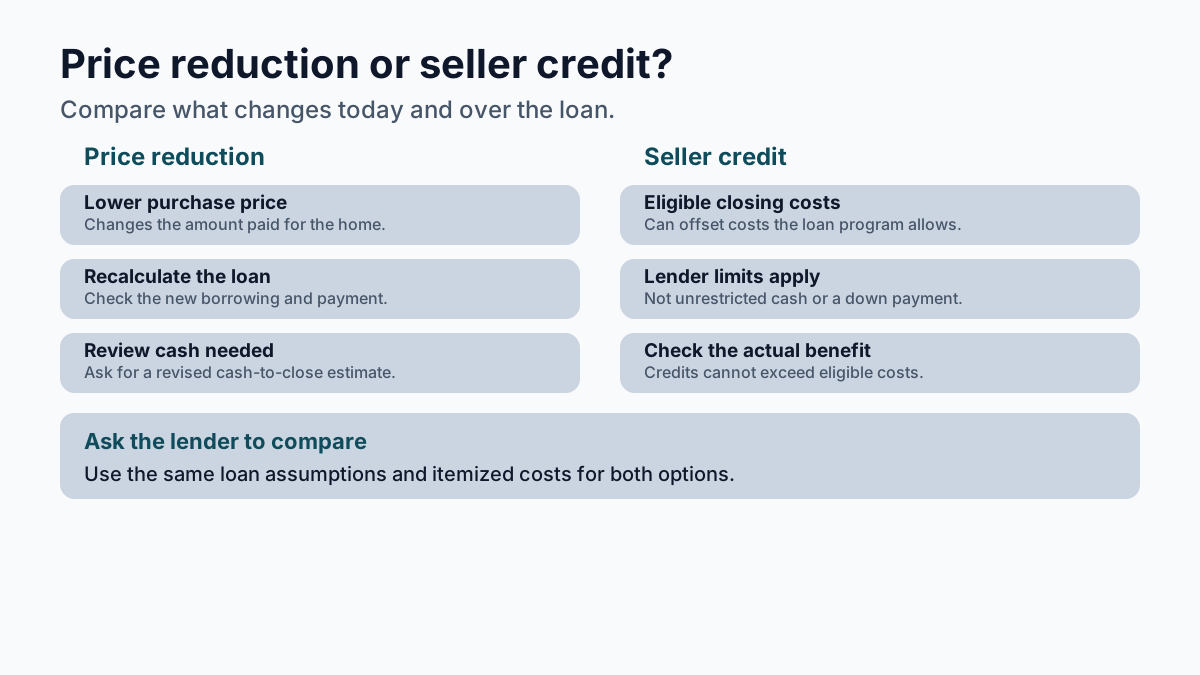
A lower price may serve a buyer focused on long-term borrowing costs, while a credit may better help someone short of cash to close. This is a comparison I would rather make with the buyer’s lender, because the actual rate, loan and cash requirements decide it.
With the same rate and term, borrowing less reduces the principal-and-interest payment and total interest. A permitted seller credit instead offsets eligible closing costs; it does not hand the buyer unrestricted cash. Have the lender compare those two effects.
Ask yourself which constraint is actually binding. If you're short on cash to close, a $10,000 credit does something a $10,000 price cut cannot do fast enough. If you're comfortable on cash and plan to hold the house for fifteen years, the price cut keeps working on the loan balance the entire time you own it.
There's a third path worth raising with your lender. In a financed purchase, a permitted seller contribution used for an approved rate buydown can affect the payment differently from an equal price change. That math belongs to the buyer's lender, not to me. The lender has to run the actual scenario with the actual loan program and show you both columns side by side. What I can do is make sure the contract is written so the option stays available.
What if the seller won't pay closing costs?
If the seller says no to closing costs, a buyer can still ask for a repair credit, trade on the closing date, take a lender credit, or shop the title and settlement fees. A no isn't the end of the conversation. It's a data point about how that seller is positioned, and there are other levers on the board.
- Ask for a repair credit tied to a specific inspection item instead of a general credit.
- Ask the seller for a date rather than a dollar, if timing is what they're protecting.
- Take the lender credit route, with the tradeoff priced out in writing.
- Shop the buyer-controlled services, since title and settlement providers aren't identical on fee.
- Reprice the offer and ask for nothing, if the property is worth it without help.
Sometimes a seller says no because they've run their own net sheet and the number doesn't work. That's fair. A seller carrying a 20-year-old roof, a commission line and the deed tax on the sale price has a floor too, and pretending otherwise wastes both sides' time.
Does the time of year change who pays?
The time of year doesn't decide who pays, though a named storm in the Atlantic or bookings on a short-term rental can complicate the closing. People ask which month is hardest to sell in, hoping the calendar will explain a slow sale. I won't hand you a month, because on Amelia Island the competition on your street matters more than the page on the calendar. A well-prepared house with two comparable listings nearby is in a different negotiation than the same house with nine.
Two seasonal details here do carry real consequences for a closing date.
If a named storm is in the Atlantic, ask your lender and insurance agent early how they handle binding coverage, because a delayed closing has costs of its own. And if your sale involves a short-term rental with bookings on the calendar, sort out how those transfer long before anybody is negotiating over a credit at closing.
What should a seller check before negotiating closing costs?
My seller review starts with the homes competing for that buyer right now, not only a sale that closed months ago. Then roof age and documentation, HVAC, water heater, electrical, plumbing, and visible deferred maintenance, before anyone talks about paint or carpet.
The roof is usually the pivot. A roof around 20 years old calls for a documented plan. The owner can replace it and account for the work in pricing, or understand in advance how a replacement request would be handled before closing. What you don't want is to discover that question in week three, with a buyer already drafting a credit request.
Competition belongs in that decision. I once advised an owner to pause rather than list, because a builder was offering the same floor plan for about $20,000 less than that owner had paid, and advertising 3.99 percent financing on top of it. A lender needs to compare the actual payments; the builder's advertised offer belongs in that comparison. Knowing that before you list is the difference between a strategy and a surprise.
If you're weighing an offer here and can't tell whether to argue about the price or the credit, I'm glad to walk through the numbers with you and your lender before you answer.
So, who pays closing costs on a house?
Both sides can pay closing costs, and the agreements set the allocation within legal and loan-program limits. Use the CFPB’s 2% to 5% buyer estimate as a starting point, calculate the deed tax, and get an itemized estimate of the commission, title, loan and prepaid charges assigned to each party.
The number on a closing statement is the last thing negotiated and the first thing people forget to plan for.
A price tells you what a house costs. A closing statement tells you what the agreement cost.
Frequently asked questions
Which side pays more at closing, the buyer or the seller?
It depends on the contract, commission agreements and loan. Buyer closing costs commonly run 2% to 5% of the price excluding the down payment. Florida deed tax is $0.70 per $100 or fraction outside Miami-Dade, but compare itemized estimates before assuming which side pays more.
How much are closing costs for a $400,000 house?
At 2% to 5%, a buyer’s estimate is $8,000 to $20,000 excluding the down payment. Outside Miami-Dade, deed tax on a $400,000 taxable sale is $2,800. Commission and the allocation of other expenses depend on the agreements.
Why would a seller agree to cover a buyer's closing costs?
A credit can help cover eligible costs or resolve a repair negotiation. The lender must approve both the amount and its use. Fannie Mae uses 3%, 6% or 9% limits for primary and second homes based on loan-to-value, and 2% for investment properties; actual eligible costs also limit the credit. VA separates ordinary closing-cost credits from concessions capped at 4% of reasonable value. Ask the lender for the rule governing the actual loan.
How likely is it for a seller to pay closing costs?
It comes down to how the whole offer reads, because a seller weighs the credit against the price, the inspection period, the closing date, and the loan program named in the lender letter. A specific figure tied to a specific loan program is a term a seller can say yes to, while a vague request to cover the buyer's costs invites them to imagine the worst number.
What is the hardest month to sell a house?
There isn't one month I'd point to, because on Amelia Island the competition on your street matters more than the calendar. A well-prepared house with two comparable listings nearby is in a different negotiation than the same house with nine.
Sources reviewed
- CFPB — who generally pays closing costs
- CFPB — a lender credit isn't free
- CFPB — buyer closing costs 2%-5% of price
- Florida DOR — documentary stamp tax standard rate
- Florida DOR — Miami-Dade documentary stamp exception
- Fla. Stat. §28.24(13) — clerk recording fees
- NAR — written buyer agreement now required
- NAR — buyer-agent compensation no longer on MLS
- Fannie Mae IPC guide
- VA closing costs and concessions
- Official AS IS contract clause9
- KeyCrew interview with Angie Heitzer