A CDD fee is a non-ad valorem assessment levied by a community development district, which Florida law defines as a local unit of special-purpose government created under Chapter 190 and limited to the functions that chapter authorizes. It repays the bonds that built the community's infrastructure and it funds the upkeep of what those bonds paid for. In Nassau County, it is included on the annual property tax bill.
For a parcel in Amelia Walk or Heron Isles, check the annual tax bill for the district assessment and confirm the current amount with the district.
Look for it on the annual bill and ask the district how your parcel is billed. A lawfully imposed assessment is not optional.
That's the part buyers miss when they're comparing two houses at the same asking price.
What is a community development district?
A community development district is a unit of local government, and Chapter 190 keeps it narrow on purpose. A district exists to build, own, and maintain infrastructure, and to levy the assessments that pay for it.
That narrowness is the real answer to the question people are usually asking. A district is a government with the power to levy assessments on benefited property inside its boundary. A homeowners association is a private organization you join by buying inside it. A community can have both.
Nassau County has several districts. Amelia National Community Development District is one, and by its own account it's an independent special district under Chapter 190 covering approximately 876.40 acres entirely within the county, created to fund, install, operate, and maintain public infrastructure including drainage, water and wastewater, roadways, and recreational improvements.
That list is the whole point of the mechanism, and on this ground it's expensive work.
Drainage, water systems, and roads take money to build. They need money to maintain after the houses close, too.
What does a CDD fee in Florida actually pay for?
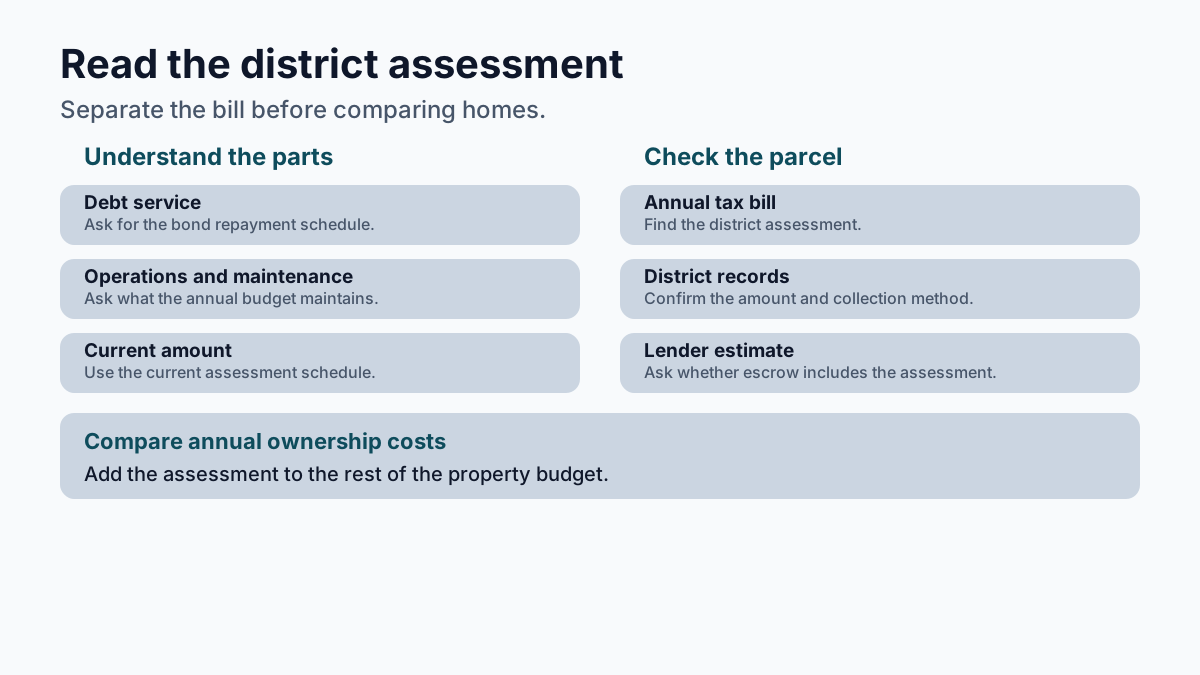
A CDD fee pays for two things: the bonds that built the community's infrastructure, and the upkeep of what those bonds paid for. Two separate assessments hide behind that one phrase, and they behave differently.
One is ongoing. A district's board may levy a maintenance special assessment to maintain and preserve the district's facilities and projects, which is the money that keeps the ponds, the lighting, and the shared infrastructure working.
The other is construction debt. Each year the board levies the annual installment of benefit special assessments for the bonds issued to build the place to begin with.
So when someone quotes you one annual number, ask which part is which.
The debt portion follows the schedule of the bonds behind it. The maintenance portion continues as long as there's something to maintain. Both amounts are set each year by the district's own governing board, which is why last year's figure is a reference point and not a promise.
Why is a CDD fee on your tax bill instead of a separate invoice?
In Nassau County, CDD fees are included on the annual property tax bill. Florida law allows districts to use that collection method.
When the district uses the tax-roll collection method described in Florida law, it certifies the assessment by August 31 and the tax collector collects it with county taxes. The statute also allows other lawful collection methods.
In Nassau County they're billed as a flat rate added to the tax roll and folded into the total amount due for the parcel. The county's roster of districts includes Amelia Concourse, Amelia National, Amelia Walk, Heron Isles, River Glen, Three Rivers, and Liberty Cove.
Two practical things follow from riding the tax bill.
If your lender escrows your taxes, ask it to confirm that the district assessment is included in the escrow estimate. It is part of the same annual tax bill, but you want the full amount in your payment calculation.
And it carries the enforcement weight of a tax bill, which is why it isn't a charge you can decline.
What does the purchase contract have to tell you about a CDD?
Florida law requires the contract for the initial sale of property inside a district to carry a bold disclosure stating that the district may impose and levy taxes or assessments on the property, and that those amounts are set annually by the governing board.
That protection is written for the initial sale.
Buy the same house from its second owner and the statutory notice isn't what stands between you and a surprise. Your own diligence is, along with your agent's.
How do you find the number for a specific address?
The number for a specific address sits on that parcel's most recent tax bill, and the district itself can give you the current schedule. Not from the property appraiser.
The Nassau County Property Appraiser's office does not have that information. The figure lives with the Tax Collector's office and with the district itself.
The check is short, and it belongs before the offer rather than after the inspection.
- Read the most recent tax bill for that exact parcel and find the non-ad valorem section.
- Ask the district for its current adopted budget and assessment schedule.
- Ask which share of the annual amount is debt service and which share is operations and maintenance.
- Ask when the bond portion is scheduled to be paid off.
Say you buy a second home you expect to make your primary retirement home later, using it part-time in the meantime. A district assessment doesn't care how many nights a year anyone sleeps there. It's an annual cost of owning the parcel, so it belongs in the second-home math from the start.
Is a district assessment a reason to rule a community out?
Only if you never find out what it is.
State the constraints plainly. The assessment is mandatory, the amount is set by the district's governing board, and it changes what a given purchase price costs you every year.
The rest is just as true. Those assessments help fund community infrastructure, and unlike most of what surprises people in a transaction, this cost is written into public records you can read before you commit.
A community with an assessment and a lower purchase price can carry better than a community without one. It can also carry worse. The only way to know is to run both to an annual total instead of a sticker price.
What an island address costs to carry overall, with county millage, homestead, and the wind and flood coverage, is a larger question than this one and deserves its own accounting.
A cost you understood before the offer is part of the budget. The same cost, found at the closing table, is a problem.
If you're weighing communities around Amelia Island, Yulee, and the rest of Nassau County and want to know what each one actually costs to own, I'm glad to pull the bills and walk through the real numbers with you.
Frequently asked questions
Is a CDD fee the same as an HOA fee?
No. A community development district is a unit of special-purpose government created under Chapter 190 of the Florida Statutes, and Florida law permits collection with county property taxes. Nassau County includes CDD assessments on its annual bills. Homeowners association dues are billed privately by the association, and a community can have both.
How long do CDD fees last?
The two parts run on different clocks. The benefit special assessment installment exists to repay the bonds issued for the community's infrastructure, so it follows that debt's schedule, while the maintenance special assessment can continue as long as the district has facilities and projects to maintain. Both amounts are set each year by the district's governing board.
Does a Florida purchase contract have to disclose a CDD?
Florida law requires the contract for the initial sale of property inside a district to carry a bold disclosure that the district may impose and levy taxes or assessments, set annually by its governing board. That requirement is written for the first sale, so a resale buyer should verify the assessment independently.
Who can tell me the CDD fee on a specific Nassau County property?
The Tax Collector's office and the district itself. The Nassau County Property Appraiser's office states that it does not have any information regarding what your CDD fee is.
Sources reviewed
- Florida Statutes §190.003(6) — definition of "community development district" (Florida Senate)
- Florida Statutes §190.021 — certification and collection of CDD assessments (Florida Senate)
- Florida Statutes §190.048 — required disclosure to purchaser (Florida Senate)
- Nassau County Tax Collector — Non-Ad Valorem Taxes
- Nassau County Property Appraiser — FAQs
- Amelia National Community Development District — official site
- Florida Statutes 720.301 HOA definitions