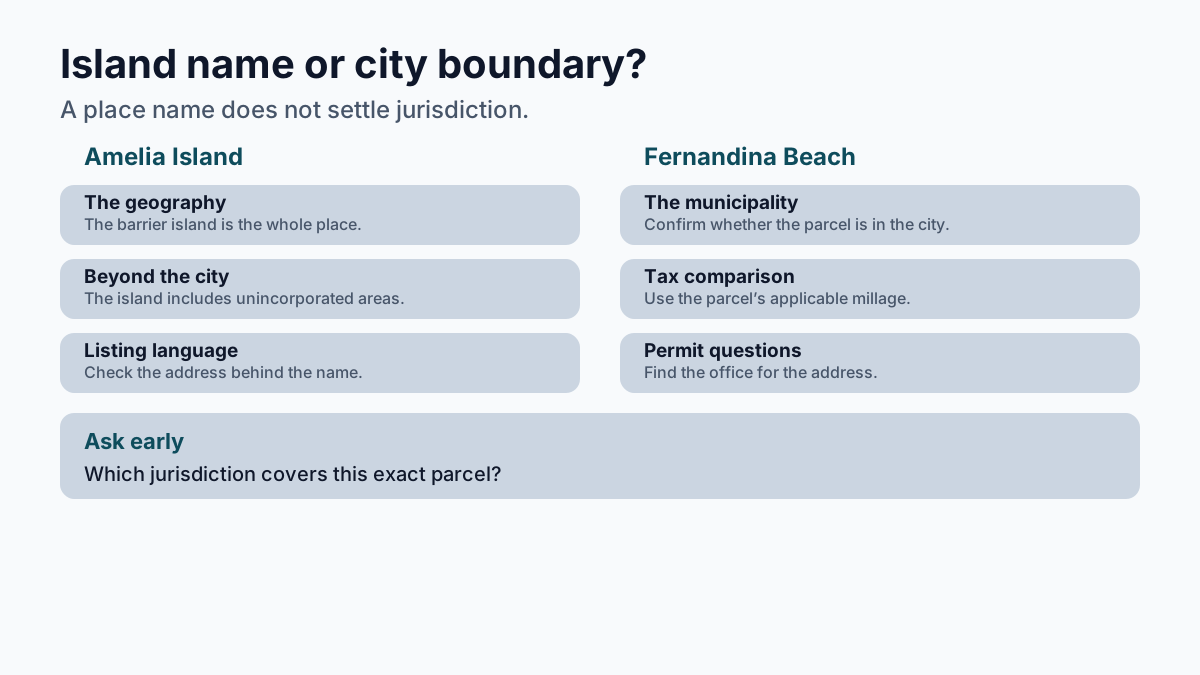
Amelia Island is the whole barrier island. Fernandina Beach is the incorporated city on the island's northern end. The two names aren't interchangeable. Everything south of the city limits sits in unincorporated Nassau County, which means a different government and a different tax bill on the same island.
Buyers often meet that distinction after the fact.
Jim and I bought a second home on the island in 2020 and told ourselves we'd make the real move in about five years. We were living in Fernandina Beach inside of a year.
Somewhere in there the two names stopped being scenery and started being paperwork.
What is Amelia Island, exactly?
It's a barrier island, thirteen miles long and about four miles wide at its widest point, and the southernmost of the Sea Islands that run down the Atlantic coast.
That's the whole landmass. The dunes on the north end, the marsh side, the maritime forest, the two-lane stretches where the live oaks close over the road.
An island is geography. Geography doesn't set a tax rate.
Where do the Fernandina Beach city limits end?
The city's limits stop before the island's southern end, which the county's own tax chart lists separately as unincorporated. Fernandina Beach is a city in Nassau County and the northernmost city on Florida's Atlantic coast. The 2020 Census Gazetteer recorded 11.832 square miles of land and another 0.788 square miles of water.
The island runs thirteen miles. The city doesn't.
The center of it is Centre Street, an eight-block downtown historic district sitting inside a 50-block Victorian-era national historic district with more than 400 historic homes, churches and commercial buildings. The Fernandina Beach Historic District went on the National Register of Historic Places on July 20, 1973.
Practically, the farther south you look, the likelier you are to be outside the city. The county's own tax chart keeps a separate line for the unincorporated southern end of the island, which is the plainest proof that the island keeps going after the city stops.
What does Amelia Island vs Fernandina Beach mean on your tax bill?
In 2025 the total millage was 18.0222 mills inside the City of Fernandina Beach and 15.4500 on the island's unincorporated southern end, a spread of about $2.57 per $1,000 of taxable value. This is the part to write down before you fall for a house.
For 2025, the total millage ran:
- 18.0222 mills inside the City of Fernandina Beach
- 15.4500 mills on the unincorporated southern end of Amelia Island
- 15.3517 mills in unincorporated Nassau County
A city levies its own millage on top of the county's, so the same house carries a different total depending on which side of the limits it lands on.
The spread between the city and the island's unincorporated south end is 2.5722 mills, or about $2.57 for every $1,000 of taxable value. On a home taxed at $400,000, that comes to roughly $1,029 a year. This is a same-taxable-value illustration, not a quote for a particular parcel; exemptions and non-ad valorem assessments can change the actual bill.
A millage rate is a line item, and it belongs beside the floor plan rather than after the offer. Two houses can share a beach and a sunrise and still sit under different governments.
Values have been moving underneath all of it. The city's estimated taxable value for 2025 came in at $4.7 billion, up 8.5% year over year. Nassau County Property Appraiser Kevin Lilly said sales tracked through 2024 and into the first quarter of 2025 showed values increasing overall, with appreciation uneven from one market segment to the next.
What else is on the island besides the city?
The island also holds distinct communities beyond the historic downtown, American Beach among them.
American Beach was established in 1935 by the Afro-American Life Insurance Company under its president, Abraham Lincoln Lewis. Its historic district was added to the National Register on January 28, 2002.
Farther down the island, the county's millage chart keeps its own line for the unincorporated stretch it calls Island-South.
So "Amelia Island" on a listing tells you which island. It doesn't tell you which government.
Are Old Town and Downtown the same place?
Old Town and Downtown are two different places. Inside the city, one name splits again.
Old Town is the original 1811 townsite, which the city describes as the last Spanish city platted in the Western Hemisphere. The Downtown historic district came later and is its own place, with its own street grid and its own feel.
The island has been under eight different flags since first European contact, which the city calls the only U.S. location to have done that. The Isle of Eight Flags nickname comes from there, and it gets used loosely for the whole island.
How do you use the difference while you're house hunting?
Ask which jurisdiction a parcel sits in before you ask anything else about it.
Ask for the millage on that exact parcel, not the neighborhood average.
Ask which office you'd be calling with a permit question on that address.
Listings lean on the island name because it's the one people search, and that shorthand is where the surprises live. The fix costs one question, asked early.
None of this ranks one side of the line above the other. It means two houses that photograph the same can cost different money and answer to different desks, and that is a question with an answer rather than a risk you carry into closing.
The island is what you came for. The line inside it is what you'll live with.
If you're weighing a place inside the city against one farther down the island, I'd be happy to walk through what each address changes about an ordinary week here, from the tax line to the drive you'd make most mornings.
Love Where You Live.
Frequently asked questions
Is Amelia Island the same as Fernandina Beach?
No. Amelia Island is the barrier island, and Fernandina Beach is the one incorporated city on it, sitting on the northern end. Both names get used on mailing addresses and listings, but only Fernandina Beach is a jurisdiction with its own millage rate.
Is Fernandina Beach worth visiting?
Its downtown is built around Centre Street, an eight-block historic district inside a 50-block Victorian-era national historic district with more than 400 historic homes, churches and commercial buildings. The Fernandina Beach Historic District has been on the National Register of Historic Places since July 20, 1973.
What is the nicest part of Amelia Island?
There isn't one answer, because the island holds several distinct places. Fernandina Beach occupies the northern end with the historic downtown, while separate communities sit farther south, including American Beach, whose historic district was added to the National Register in 2002.
What's so special about Amelia Island?
It's a barrier island thirteen miles long, the southernmost of the Sea Islands, and it has been under eight different flags since first European contact. Its downtown historic district went on the National Register of Historic Places in 1973, and the city describes Old Town, the original 1811 townsite, as the last Spanish city platted in the Western Hemisphere.
Sources reviewed
- City of Fernandina Beach official site — Amelia Island dimensions
- City of Fernandina Beach official site — Isle of Eight Flags
- City of Fernandina Beach official site — Old Town vs Downtown historic districts
- U.S. Census Bureau 2020 Gazetteer — Fernandina Beach city land area
- National Park Service NRHP asset detail — Fernandina Beach Historic District
- National Park Service NRHP asset detail — American Beach Historic District
- Nassau County Property Appraiser — 2025 Final Millage Rates
- Nassau County Property Appraiser press release — Fernandina Beach taxable value
- Nassau County Economic Development Board — downtown historic district scale
- Friends of American Beach — founding of American Beach
- Angie Heitzer — official first-person biography