Start with two local checks for an Amelia Island vacation rental. Inside Fernandina Beach, a short-term rental needs a Resort Rental Dwelling Permit, with R-3 zoning or maintained grandfathered status. On Amelia Island, qualifying stays of six months or less are subject to the county-administered 5 percent tourist development tax. Those are starting points: state licensing, other taxes and association restrictions also need checking.
Two houses can sit ten minutes apart, list in the same price range, and give you opposite answers about whether they can rent by the week.
One is a cottage a few blocks off Centre Street. The other is out where the sidewalk ends and the shoulder starts.
The listing photos won't tell you which is which. The zoning map will.
Who sets the rules for Amelia Island vacation rentals?
Two local checks start with the city of Fernandina Beach and Nassau County: the city’s rental permit and the county-administered Amelia Island bed tax. Florida’s vacation-rental licensing rules are a separate check.
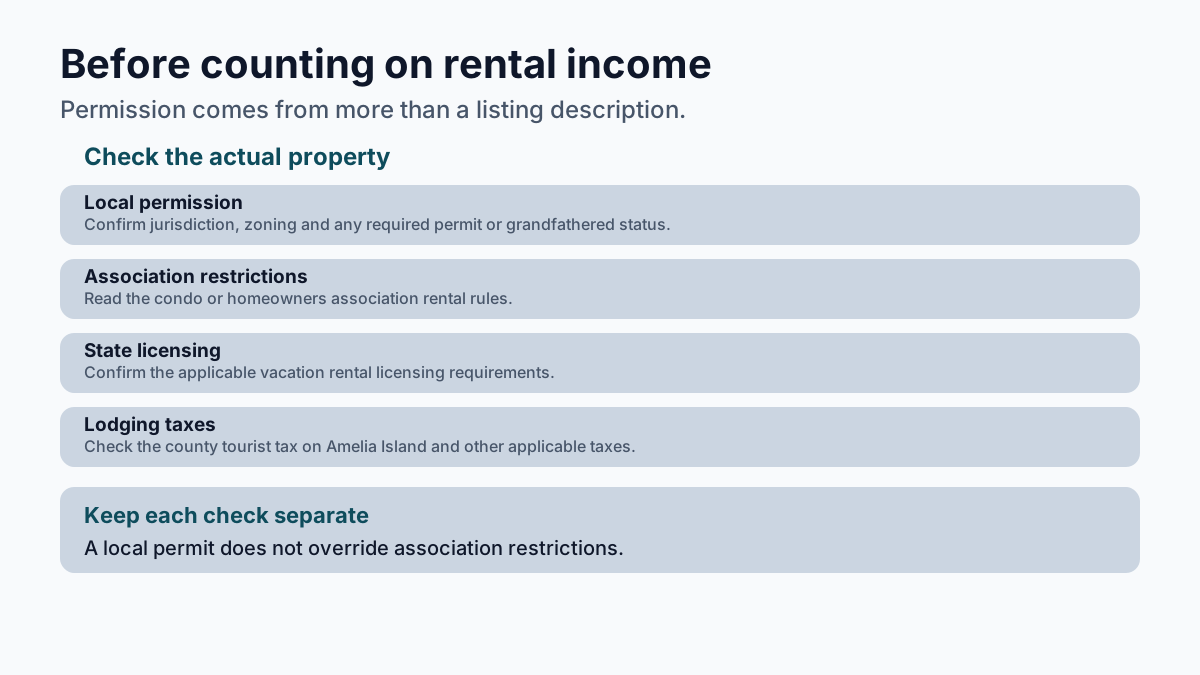
The city’s resort rental permit governs addresses inside Fernandina Beach. The Amelia Island tourist development tax applies to qualifying transient stays of six months or less on the island, including its incorporated and unincorporated areas; it is not a countywide levy.
That is why "it's on the island" never answers the rental question. The useful first question is what the parcel is zoned and which side of the city line it falls on.
Which homes qualify for a Fernandina Beach short-term rental permit?
A home zoned R-3 can get the permit, and so can an R-1 or R-2 home with grandfathered status. The city's rule is narrow, and it's written down plainly.
- Short-term rental is permitted in R-3 High Density Residential zoning.
- R-1 and R-2 properties qualify only if they have been granted grandfathered status.
- Grandfathering depends on qualifying operation before October 3, 2000 and maintained permit status; the city also specifies a 180-day lapse condition.
- Maintained grandfathered status transfers with the property address, not the owner; confirm the current record with the city.
- A home that doesn't qualify has a minimum rental duration of 30 days or more, classified as long-term.
The fourth line is the one worth reading twice.
Qualifying grandfathered status follows the property address rather than the seller. But do not assume an old rental listing proves it still exists: ask the city to confirm the address’s current status and permit history before relying on it.
So ask for the permit record in writing. A neighbor's summer schedule is not evidence, and neither is a listing remark.
What does Florida law actually preempt?
Florida statute 509.032(7)(b) bars a local law from prohibiting vacation rentals or regulating the duration or frequency of vacation rental stays.
Then it draws a line in time. That restriction does not apply to a local law, ordinance, or regulation adopted on or before June 1, 2011.
Older local rules stand. Newer ones can't reach as far.
Fernandina Beach already had an October 3, 2000 cutoff written into its resort rental rules, which puts that framework more than a decade ahead of the state's line.
How much is the Nassau County transient rental tax?
Nassau County's tourist development tax is 5 percent, effective July 1, 2018 under County Ordinance 2018-16.
It is due to the Tax Collector's office monthly, on the first day of the month following the reporting period, and it becomes delinquent if it isn't paid or postmarked by the 20th.
An income estimate that leaves the tax out has a hole in it, and the hole grows with every booking.
Where does the bed tax go?
The bed tax funds the Amelia Island Convention and Visitors Bureau, a nonprofit created in 2008 that runs on the 5 percent tax on short-term lodging. The county has collected the Amelia Island tourist development tax since January 1, 1989.
The Amelia Island Convention and Visitors Bureau, a 501(c)(6) nonprofit created in 2008, runs on that 5 percent tax on short-term lodging.
Its figures put tourism at 12,700 jobs, 27.8 percent of all jobs in the county, and more than $949 million of economic impact. Hotels and vacation rentals together contribute more than $23 million in property taxes according to the bureau’s background page, which does not date the underlying figures.
A visitor economy that size is why the rules exist at all, and why they get enforced.
What does the rental answer change for a buyer?
The rental answer decides whether the weeks you're not here earn something, or whether the carrying cost is yours alone. A pattern I see often here: an out-of-state buyer buys a second home to enjoy part-time, with plans to make it a full-time home later.
The rental question sits right in the middle of those years.
If the address can legally rent short-term, the weeks nobody is using have something to do. If it can't, the carrying cost is yours alone, and the home has to earn its keep on the mornings you're actually in it.
Both of those can be good buys. They're different math, and the parcel decides which one you're doing.
There's a third path people forget. A home that can only rent for 30 days or more is still a rental home, and a winter tenant on a long lease is a different business from a stack of weekends.
What should you verify before you write an offer?
Five things need checking before the offer: the parcel's zoning, any grandfathered status in writing, what the association allows, who files the tax return each month, and whether the home still works if it never rents.
- The zoning designation on that exact parcel.
- Whether grandfathered status exists for the address, documented rather than described.
- What the association or condominium documents allow, since a city permit is not an association's permission.
- Who files the tourist development tax return each month, and when.
- Whether the home still makes sense if it never rents a single night.
None of that takes long. It belongs in the same file as the survey and the roof age, and it belongs there before the offer rather than after the inspection.
That is the work a local agent should be doing while you're still deciding how a place feels on a Saturday morning.
Some homes pay for themselves by the week. Others pay for themselves by the morning.
If you're weighing a second home here and the rental question is part of the math, I'd be glad to walk a specific address through its zoning, its permit record, and what a realistic calendar would look like.
Frequently asked questions
Does Florida law override Fernandina Beach's short-term rental rules?
Not the older ones. Florida statute 509.032 says a local law may not prohibit vacation rentals or regulate the duration or frequency of vacation rentals, but that restriction does not apply to any local law, ordinance, or regulation adopted on or before June 1, 2011.
When is the Nassau County tourist development tax due?
Monthly. It is due to the Tax Collector's office on the first day of the month following the reporting period, and it becomes delinquent if it is not paid or postmarked by the 20th day of that month.
Does grandfathered resort rental status transfer when the home sells?
Maintained grandfathered status follows the property address, not the owner. Qualifying operation before October 3, 2000 is part of the rule, but so is the permit history; the city specifies a 180-day lapse condition. Obtain written confirmation of the address’s current status before relying on it in a purchase.
What are the Amelia Island condo rental rules?
The condominium or association documents matter as much as the city permit. A city permit is not an association's permission, so read what the association allows before you count on short-term rental income.
Sources reviewed
- City of Fernandina Beach — Resort Rentals (official)
- City of Fernandina Beach — Resort Rentals (official)
- Florida Statutes — 509.032(7)(b), Florida Legislature (official)
- Nassau County Tax Collector — Tourist Development Tax (official)
- Nassau County Tax Collector — Tourist Development Tax (official)
- Amelia Island Convention & Visitors Bureau — Background (official)
- Amelia Island Convention & Visitors Bureau — Background (official)
- Nassau Ordinance2018-16 Amelia Island tourist tax
- DBPR vacation rental licensing guide
- KeyCrew interview with Angie Heitzer