
To search property in Nassau County, Florida, use the Nassau County Property Appraiser's Records Search. You can look up a parcel by owner name, street address, parcel number or subdivision, and pull sales by price and date. Recorded deeds and mortgages sit separately, in the Clerk of Court's Official Records.
Say a house on a quiet street in Yulee has your attention.
Before the second showing, you want to know who owns it, what it last sold for, and what it's taxed on.
One public record answers most of that.
Owner. Parcel number. Sale history. Three values.
What the record leaves out matters just as much. That's where a careful buyer slows down.
Where do you look up a property's official record?
The official place to look up a property is the Nassau County Property Appraiser's Records Search, which covers real estate records, personal property records, and an advanced search for parcels and sales.
You can reach it from the Property Appraiser's homepage, which also links an interactive GIS map, a tax estimator, a change of address form, and online homestead filing.
This is the office the Florida Constitution and statutes charge with identifying and fairly valuing all property in the county, real and personal.
That's why I'd open it before any listing site. It's the record the county itself keeps.
When the address is the easy part and the land is the question, the GIS map is the next tab to open.
How do you search by owner, address or parcel number?
You can search by owner name, street address or parcel number, and the advanced search filters by subdivision, zone, property use, and sale price or date.
It also takes square footage, original construction year, buyer or seller name, tax district, and whether a lot is vacant or improved.
The address box uses predictive suggestions, so type slowly and let them load. If the address still won't come up, search by owner name or parcel number instead.
Once you find the parcel number, write it down.
It's the one handle that won't trip over a misspelled street name or a unit number typed the wrong way.
The sales side is where the search starts to feel like local knowledge. Pair a subdivision with a sale date range under Find Sales, and you're reading that neighborhood's sales in the county's own data.
Read those beside the asking prices on a listing site. The two tell different parts of the same story.
A North End lot, a Callahan acreage, a condo minutes from Main Beach.
The same search handles each one.
How do you find out who owns a home in Florida?
In Nassau County, the owner's name is on the parcel record in the Property Appraiser's Records Search, and the deed that transferred the property is recorded with the Clerk of Court.
The Clerk's Official Records hold deeds, mortgages, satisfactions, liens, powers of attorney, and notices of commencement, among other instruments. Documents from 1840 through 1982 sit under Historic Official Records.
The two offices work in sequence.
A deed is recorded with the Clerk, and the appraiser updates its roll from a digital copy of that recorded deed. The appraiser's office also can't help prepare a deed.
That order matters on a fresh sale. The deed comes first, and the appraiser's record follows it.
For a buyer, the Clerk's Official Records are also where mortgages and liens against a property are recorded. The appraiser's page tells you who owns the home. The Clerk's records tell you what's been recorded against it.
How do you find a property's assessed value?
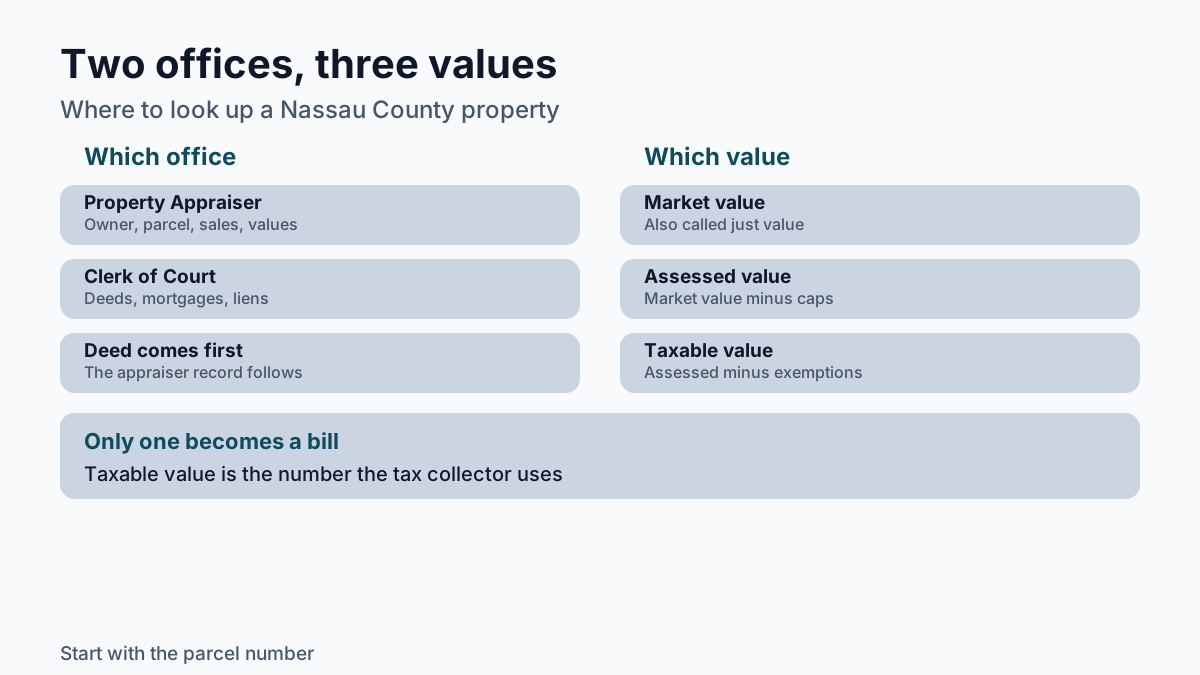
Every Nassau County parcel carries three values, and the assessed value sits on the record between market value and taxable value.
Market value, also called just value, is set every year, and the sales comparison approach is the method used most often.
Assessed value is market value minus caps, such as the Save Our Homes cap on a homestead or the 10% non-homestead cap. Taxable value is assessed value minus exemptions, and it's the number the tax collector uses.
Market. Assessed. Taxable.
Only the last one turns into a bill.
On a homestead, the Save Our Homes cap limits yearly growth in assessed value to 3% or the change in the Consumer Price Index, whichever is lower. The 2026 cap is 2.7%.
The cap limits the assessed value, not the tax. Taxes are not capped at a percentage increase, and they're set by taxable value and the millage rate together.
A long-held homestead can show an assessed value well below its market value. That gap belongs to the seller.
After a sale, Florida law requires the appraiser to reset assessed value to market value and remove the prior owner's exemptions. That reset happens the January 1 after you buy, and the prior owner's caps reset with it.
What that does to your bill is its own subject, and a separate post on Nassau County property taxes works the numbers.
Those caps are changing. Florida voters approved Amendment 3 on November 3, 2026, and it cuts the non-homestead cap from 10% to 5% for non-school taxes as of January 1, 2027.
It also raises the non-school homestead exemption to $150,000 in 2027 and $250,000 in 2028 for people who are Florida residents by December 31, 2026. Newer residents start at the existing exemption and get the larger one starting in their fifth year of exemption.
It needed 60% of the statewide vote and got nearly 62% in unofficial returns. The changes first show on the August 2027 TRIM notices.
Can the property search estimate taxes on a home you're buying?
Yes, the Property Appraiser's site has a tax estimator, but it works from the purchase price and leaves out portability from a previous homestead and any non-ad valorem assessments.
Those two gaps are spelled out by the office itself. Treat the result as a starting figure, not the full bill.
The second gap matters most in a community development district.
CDD fees are non-ad valorem assessments that appear on the annual tax bill the Tax Collector mails, and the appraiser's office has no information on what they are. The seller's most recent tax bill shows the current charge. For the amount you'll pay, contact the district directly, as the Tax Collector advises.
It also helps to know who does what. The appraiser values property, but it doesn't set tax rates or collect taxes. Taxing authorities set the millage, and the Tax Collector collects the taxes shown on the roll.
Rates, a sample bill and payment deadlines each have their own home, in the posts on Nassau County property taxes and on paying the Tax Collector.
What won't a Nassau County property search show you?
The Property Appraiser's record won't give you building permits, a survey, or a CDD fee, and each of those comes from a different office or party.
Permits. Surveys. Flood maps. CDD charges.
The office doesn't keep permits. Those come from the building department where the property sits: unincorporated Nassau County, the City of Fernandina Beach, the Town of Hilliard, or the Town of Callahan.
Those same offices can help you find zoning, flood zone details, lot splits, and elevation certificates.
Picture the morning of an inspection on an older house a few blocks off Centre Street. The inspector asks about the enclosed back porch. Any permit for that work isn't in the appraiser's file. It would be with the City of Fernandina Beach's building office. Permits from before March 2020 aren't in the city's online portal, so request those by email or public records request.
For the flood zone itself, start with that same building office. Ask for any elevation certificate it has on file, too.
Surveys are a different story. They're privately held by the company that performed them and generally aren't recorded in the Official Records. So an existing survey comes from the survey company or whoever kept a copy.
Weighing a home on Amelia Island or in Yulee? I'd be happy to read the parcel record with you before you write an offer.
What does the TRIM notice mean for the value on the record?
The TRIM, or Truth in Millage, notice shows a parcel's just, assessed, exempt, classified and taxable values, and the 2026 notices went out August 17 as notices rather than bills.
If something on it looks wrong, the window is short. Owners must raise a discrepancy with the Property Appraiser's office within 25 days of the TRIM mailing, and the deadline is printed on the form.
An owner can also petition the Value Adjustment Board over market value, a classification, or an exemption. The 2026 petition deadline was September 11, and it's printed on the notice.
Petitions go to the VAB Clerk at the Nassau County Judicial Annex, 76347 Veterans Way in Yulee. Hearings go before a Special Magistrate.
For scale, the countywide taxable value for 2026 came to about $19.7 billion, an 8.4% increase over the year before.
For a buyer, this year's notice reflects the seller's situation. Because the reset to market value takes effect the January 1 after you buy, a later notice is the one that reflects your purchase.
What should you check after you close?
After closing, confirm your deed shows up in the Clerk's Official Records, then file for homestead with the Property Appraiser if the home is your permanent residence.
To qualify, you need legal or equitable title and must occupy the home as your permanent residence as of January 1 of the filing year. If you bought the home in 2026 or earlier, you can file for the 2027 exemption through March 1, 2027.
Update your Florida driver license or ID card to the new address before you apply. Have your Florida vehicle registration, voter registration if you're registered, and Social Security number ready too.
If you own property outside Nassau County, you'll need proof that any residency-based exemption there was cancelled, effective on or before January 1. New York's STAR exemption is one example.
A recorded deed. An updated license. A filed application.
Three small errands, and the county's records catch up with your move.
Where are the Property Appraiser's offices?
The primary office is at 96135 Nassau Place, Suite 4, in Yulee, open 8:00 to 5:00, Monday through Friday.
The Fernandina Beach office at 416 Centre Street is open Wednesdays only, from 8:30 to 4:30. The Callahan office at 45401 Mickler Street keeps 7:30 to 4:30, Monday through Friday. Both close for lunch from 1:00 to 2:00.
That Centre Street office is easy to forget.
If you're on the island, plan the trip for a Wednesday and make a morning of it downtown. Any other weekday, Yulee and Callahan are open.
A listing shows you the porch.
The parcel record shows you everything the porch sits on.
Frequently asked questions
Why can't I find an address in the Nassau County property search?
The address box uses predictive suggestions, so type slowly and wait for them to load. If the address still doesn't appear, search by the owner's name or the parcel number.
Does the Nassau County property search show CDD fees?
No. CDD fees are non-ad valorem assessments that appear on the annual tax bill the Tax Collector mails, and the Property Appraiser's office has no information on them.
Can I get a copy of a property survey from the county?
Usually not. Surveys are privately held by the company that performed them and are generally not recorded in the Official Records.
Is the Property Appraiser the office that sends the tax bill?
No. The Property Appraiser sets value but doesn't set tax rates or collect taxes. The Tax Collector collects the taxes shown on the roll.
Sources reviewed
- Nassau County Property Appraiser Records Search
- Records Search About us
- Property Appraiser FAQ: search tips
- Property Appraiser FAQ: three values
- Property Appraiser FAQ: taxes higher than previous owner
- Property Appraiser FAQ: tax estimator
- Property Appraiser FAQ: taxes not capped
- Property Appraiser FAQ: CDD fees
- Property Appraiser FAQ: permits
- Property Appraiser FAQ: surveys and deeds
- Property Appraiser FAQ: how property is appraised
- Homestead page: eligibility and dates
- Homestead page: out-of-county exemptions
- Homestead page: Driver license note
- Save Our Homes page: 2026 cap
- Save Our Homes page: cap rule and loss on sale
- Save Our Homes page: portability
- 2026 TRIM press release
- 2026 TRIM press release: who sets rates
- 2026 TRIM press release: VAB
- Truth in Millage page
- Value Adjustment Board page
- Property Appraiser locations and hours
- Property Appraiser homepage
- Clerk Records Search
- Property Appraiser press release on Nov 2026 measures
- Press release: school millage
- Tax Collector homepage