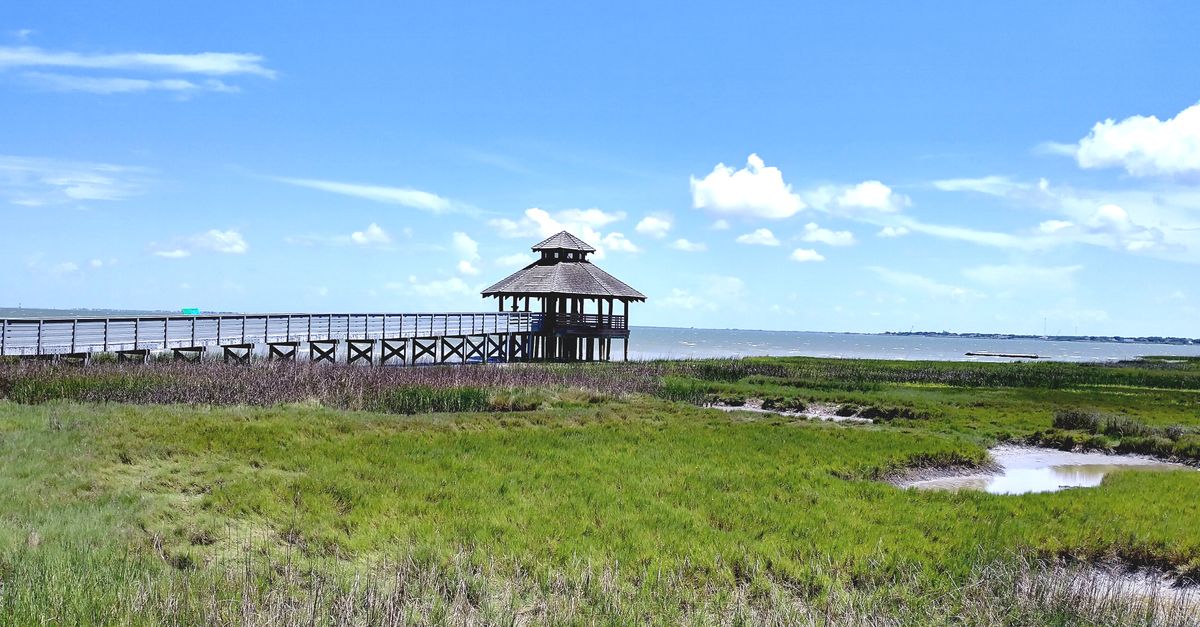
Buying waterfront property means buying a set of published rules along with the view: federal flood insurance requirements, state limits on building near the beach and dune system, dock permitting, and property tax mechanics. The agencies publish the requirements, which gives you a way to ask for property-specific quotes and permit advice before you make an offer.
Stand on a dock on the back side of Amelia Island an hour before low tide.
The water slides out of the marsh, the oyster bars come up, and what looked like open water turns into a map of creeks and mudflats.
A couple of miles east, the Atlantic is working against a dune line, a different problem with a different agency attached to it.
Both addresses say waterfront. They are not the same purchase.
What does waterfront mean near Amelia Island?
On this stretch of coast, water shows up in several forms, and each one changes the paperwork.
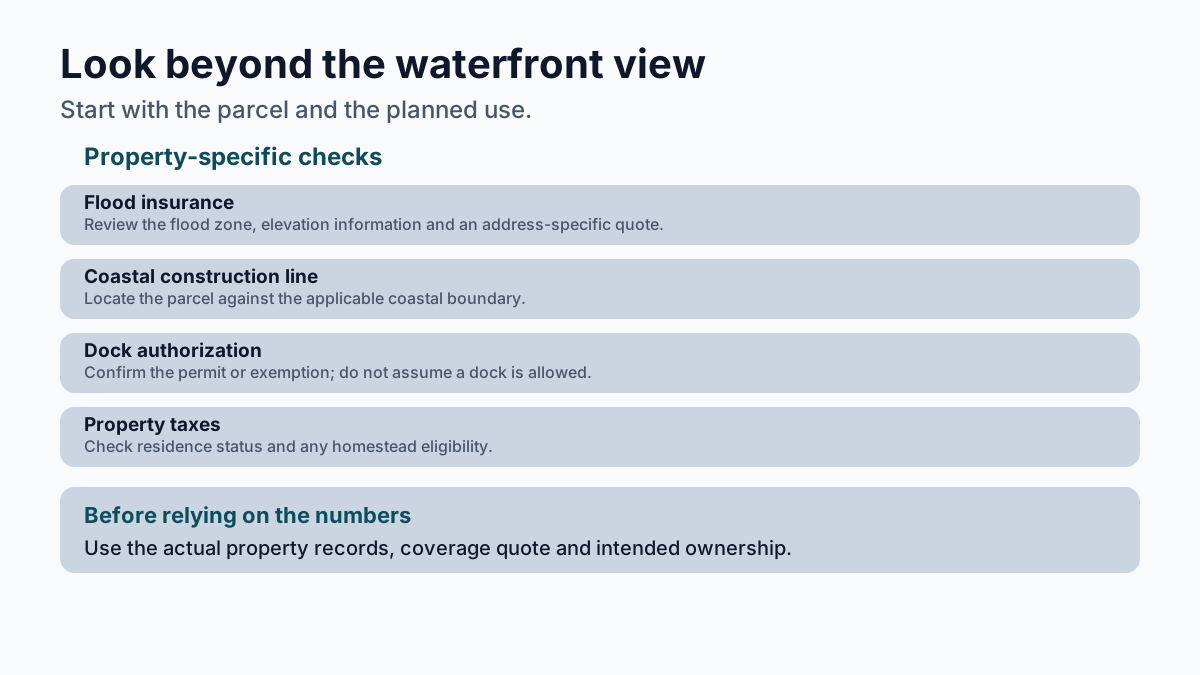
Ocean and dune frontage, where Florida's coastal construction rules apply.
Marsh and tidal creek frontage, where the view changes with the tide and the dock question gets complicated.
River frontage on the Amelia River and the Intracoastal, where boat access is usually the whole point.
Canal or basin frontage, where the waterway itself may have been dug rather than found.
That last distinction matters when you want a dock, alongside the dock’s size, design, use and location. It is one part of the permit question.
Does waterfront property have to carry flood insurance?
If the home sits in a FEMA-designated Special Flood Hazard Area and you are financing it with a government-backed mortgage, flood coverage is required. Ask the lender what applies to the address; some banks require coverage outside high-risk areas, too.
Then know what the policy actually does. A standard NFIP homeowner policy covers up to $250,000 on the building and up to $100,000 on contents.
On a waterfront home that appraises well past that, the gap is a conversation with your insurance agent early, not a discovery later.
Price isn't a single number attached to a zone. FEMA rates NFIP policies under its property-specific pricing approach, which prices each property using flood frequency, flood type, distance to water, elevation, and the cost to rebuild.
Two houses on the same street can carry different premiums, and the only way to know yours is to get a quote on that address.
Timing matters too. A new NFIP policy usually takes 30 days to take effect. Exceptions include coverage purchased with a mortgage being made, increased, extended or renewed, and certain map changes; renewal coverage changes and qualifying federal-land wildfire situations have rules of their own. Have the insurer confirm your effective date.
That's a closing-calendar item, and it belongs on the calendar the week you go under contract.
What does the Coastal Construction Control Line actually control?
The line controls what you can build or dig seaward of it along Florida's sandy beaches.
The state's Coastal Construction Control Line program regulates structures and activities that can cause beach erosion, destabilize dunes, damage upland properties, or interfere with public access. Its jurisdiction runs along sandy beaches fronting the Gulf, the Atlantic Ocean, and the Straits of Florida.
If you are shopping the marsh side, check the parcel against DEP’s map. A listing’s creek, river or marsh label does not settle where the control line falls, and other environmental rules may still apply.
Seaward of the line, a DEP permit is required for construction and excavation unless the activity is otherwise exempt.
Which is why the pool you sketched on a napkin is a permitting question before it's a budget question.
Florida hands the buyer a tool here. For property partly or wholly seaward of the line, state law requires a written disclosure at or before both parties sign the purchase contract. Separately, the seller must provide an affidavit or survey locating the line at or before closing unless the purchaser waives that requirement in writing.
The waiver is the part to slow down on. A survey showing where the line falls across your lot is the difference between knowing what you can build and hoping.
Can you build a dock?
Sometimes, and the answer starts with what kind of water you're on.
Florida’s dock exemptions depend on more than whether the waterway was dug. One route covers qualifying private recreational docks up to 500 square feet over Outstanding Florida Waters or 1,000 square feet elsewhere, with construction, navigation, use and spacing conditions. Permission to use state-owned submerged land and applicable local requirements can still matter.
Notice how narrow that is.
Have the agency or your permit professional match the proposed dock to the actual exemption and the parcel. A square-footage number on its own is not an approval.
So when a listing mentions dock potential, treat it as a question rather than a feature. Dock potential is not an approved dock, and the distance between the two is measured in permits.
How do you check the flood zone on a Nassau County address?
You look the address up, because Fernandina Beach publishes flood data address by address.
The city directs buyers to search a property by address to find its flood zone, Base Flood Elevation, Design Flood Elevation, and flood compliance warnings. Every property in the community has a public profile that homeowners, contractors, insurance agents, and real estate agents can use to review that address's flood data.
Confirm the parcel’s jurisdiction rather than rely on its mailing address. For property outside Fernandina Beach, use the county’s flood mapping and ask the responsible floodplain office to confirm the answer; the city page also links to county mapping.
The useful questions on a waterfront showing are boring ones. What's the elevation. Where does the control line fall. What does the current owner pay to insure it.
Run the lookup from your kitchen table before the showing, while the answer is still just information.
What changes on your tax bill after closing?
Two Florida mechanics, the homestead exemption and the Save Our Homes cap, decide much of the carrying cost, and both hinge on whether the home becomes your permanent residence.
For a qualifying Nassau County permanent residence, the 2027 homestead application deadline is March 1, 2027. You must hold legal or equitable title and occupy the property as your permanent residence on January 1, 2027; closing during 2026 alone is not enough.
Florida’s Save Our Homes provision generally limits annual assessed-value increases to the lower of 3 percent or the change in the Consumer Price Index, starting in the year after the property first receives homestead exemption. A purchase generally triggers reassessment, and additions have separate treatment. This limits assessed value, not the total tax bill.
A second home that is not your permanent residence does not qualify for that homestead exemption or its Save Our Homes cap. Ask the property appraiser about eligibility rather than deciding from the number of months you expect to spend there.
That distinction matters early, because a waterfront purchase often starts as one thing and becomes another. My husband Jim and I bought a second home on Amelia Island in 2020, expecting it to become our full-time home about five years later. We sold the Atlanta house and moved to Fernandina Beach within a year.
Are these rules a reason not to buy on the water?
None of this is an argument against buying on the water.
These published rules give you practical checks to make before you buy. The flood premium is a quote you can request. The control line is something to locate on a survey. The dock is a permit question to ask while you still have room to walk. The tax treatment starts with your intended use and the county’s eligibility and filing rules.
What you can't order later is the water itself, or the way the tide reorganizes the view as it rises and falls whether or not anyone is watching.
Anyone can fall in love with a view. The buyers who keep loving it are the ones who read the rules first.
If you're weighing a marsh-front lot against something on the ocean side, I'd be glad to walk through what each one commits you to before you're under contract.
Love Where You Live.
Frequently asked questions
Where can I look up a property's flood zone before making an offer?
Fernandina Beach’s public flood portal offers address-level profiles with flood zone, Base Flood Elevation, Design Flood Elevation and compliance information. Confirm the parcel’s jurisdiction; for property outside the city, use county mapping and the responsible floodplain office. A mailing address alone does not settle city limits.
Does a private dock in Florida always need a state permit?
Some private docks qualify for statutory exemptions, but size alone does not decide it. One route allows up to 500 square feet over Outstanding Florida Waters or 1,000 square feet elsewhere, subject to construction, navigation, recreational-use and spacing conditions. Confirm the applicable route and any state-land or local requirements for the proposed dock.
How soon does flood insurance take effect after I buy it?
Usually 30 days. Exceptions include buying coverage while making, increasing, extending or renewing a mortgage; changing coverage at renewal; and qualifying recent map changes or federal-land wildfire situations. Those last two have specific timing conditions and one-day waits. Ask the insurer to confirm the policy’s effective date before relying on it for closing.
Does a waterfront second home qualify for Florida's homestead protections?
Homestead is for a qualifying permanent residence. For 2027 in Nassau County, you must hold title and occupy the property as your permanent residence on January 1 and apply by March 1, 2027. Save Our Homes generally caps annual assessed-value increases at the lower of 3 percent or CPI starting the year after first homestead qualification; it does not cap the total tax bill.
Does the Coastal Construction Control Line apply to marsh-front property in Fernandina Beach?
Do not decide from a marsh-front label. DEP’s control-line program covers the sandy beach and dune system, and its mapping lets you check the actual parcel and project against the line. Other environmental, dock and local rules can apply even when the project is outside CCCL jurisdiction.
Sources reviewed
- FEMA / FloodSmart.gov — NFIP residential coverage limits
- Florida DEP — Coastal Construction Control Line Program overview
- Florida DEP — Apply for a CCCL Permit
- Florida Statute 161.57 — Coastal properties disclosure statement
- Florida403.813(1)(b)private dock exemption
- City of Fernandina Beach — Flood Protection page
- City of Fernandina Beach — Know Your Flood Zone / Forerunner portal
- Nassau County Property Appraiser — Homestead Exemption filing
- Florida Statute 193.155 — Homestead assessment limitation (Save Our Homes)
- NFIP eligibility and mandatory mortgage coverage
- NFIP April2024 Flood Maps and Zones
- DEP Locate the CCCL
- Angie Heitzer official profile and approved public-experience ledger