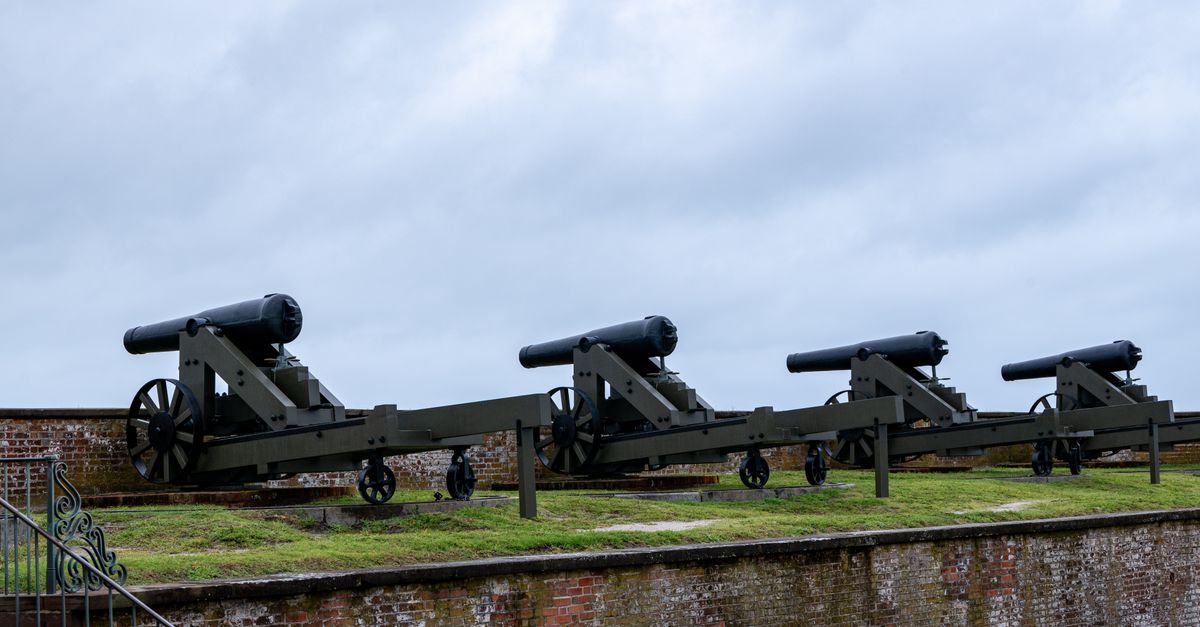
Fort Clinch State Park sits at the north tip of Amelia Island, and inside it stands Fort Clinch, a pentagonal masonry fort. Construction began in 1847, and it was never fully completed. Confederate and then Union troops held it in the Civil War, and it served again in 1898 and World War II without direct combat. Florida made it one of its first state parks in 1935.
Most forts are remembered for a battle.
This one is remembered for standing watch.
It guarded a harbor through three wars, changed hands without a fight, and then sat empty long enough to need digging out. To follow that story, start with what the fort was built to protect.
Why was Fort Clinch built at the mouth of the St. Marys River?
Fort Clinch was built at the mouth of the St. Marys River to protect Fernandina's natural deep-water port, the eastern link of Florida's only cross-state railroad.
That harbor is the whole reason the fort exists.
A deep port with a rail line running inland was a door into the state. Doors get locks.
The location rationale also explains the name. The fort honors Gen. Duncan Lamont Clinch of the Second Seminole War.
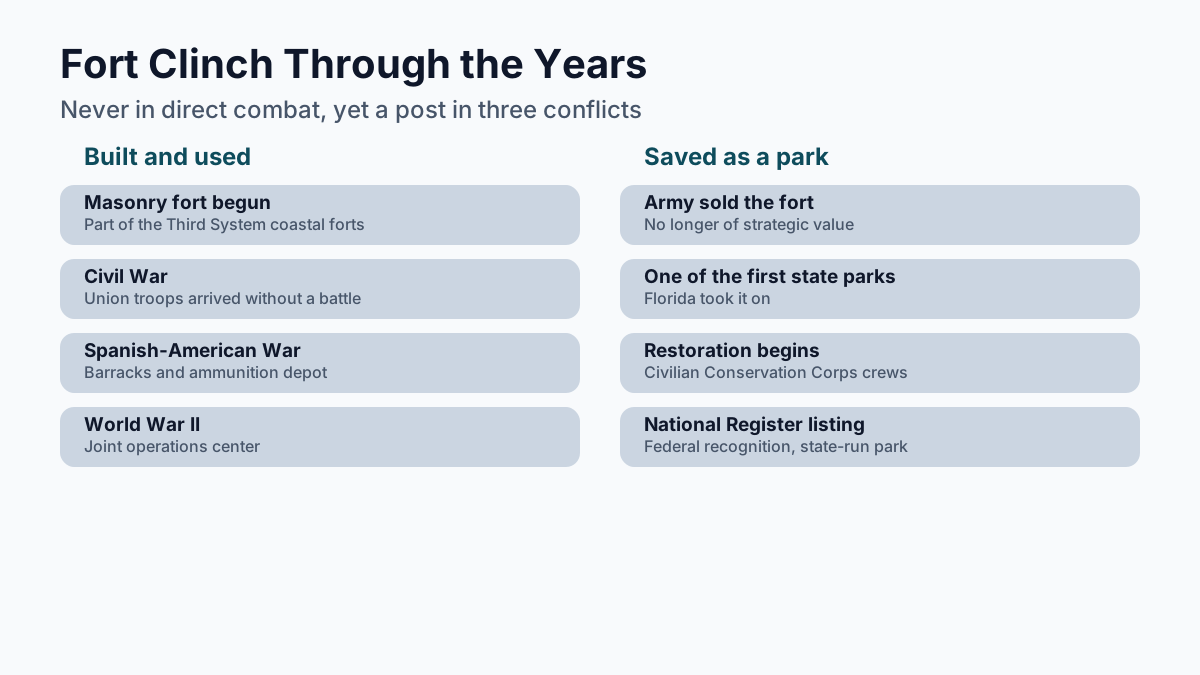
Work started in 1847 as part of the Third System of masonry coastal forts. The ambition was a fort of masonry and stone that could hold a coastline. Civilians and the U.S. Army Corps of Engineers did most of the building, and the plan was to protect the coast of southern Georgia as well. The 1971 National Register nomination gives the same 1847 start.
Brick. Concrete. Five sides.
The same nomination describes a pentagonal structure of brick and concrete. Tunnels run through the inner wall. The eight-foot outer wall is pierced with loopholes for musketry, the openings soldiers fired through.
Walk a bastion on a cool morning and the purpose is easy to read. The fort was built to watch a river mouth, and it still looks the part.
What happened at Fort Clinch during the Civil War?
Confederate troops garrisoned Fort Clinch in 1861, then evacuated on Gen. Robert E. Lee's order, and Union troops arrived in March 1862 without a battle.
The fort wasn't ready for a war.
When the conflict began, only about two-thirds of it was complete and no cannons were mounted. Fourteen years of work, and about a third of the fort was still unbuilt.
The harbor mattered more than the masonry. About 2,000 Confederate troops held the fort in 1861. The port was a haven for blockade-runners, the ships that tried to slip cargo past the Union blockade. It sat considerably nearer than any other such haven to the neutral ports at Bermuda and the Bahamas.
That was the value of the place, and it had little to do with the walls.
The order to evacuate came from Lee, and the fort passed to the Union without a siege. The Union stayed. The rooms visitors walk through today are furnished to look the way they did during that occupation.
Florida State Parks says that by 1869 the fort sat empty, though the Army kept it on caretaker status until 1898.
Did Fort Clinch ever see combat?
Fort Clinch never saw direct combat, but it served as a military post during three U.S. engagements: the Civil War, the Spanish-American War and World War II.
A fort that never fought can sound like a footnote. Here it reads the other way.
Three times, the military came back to this point of land.
In 1898 the fort became a barracks and ammunition depot, with a minefield placed outside the walls. Long after the fort had been left empty, the Army still found a use for it.
Its final mission came in World War II. The fort served as a joint operations center for surveillance and communications. When the war ended, it was given back to the state to open to the public.
So the record is quieter than a battlefield's. It's also longer, running from the 1860s to the 1940s.
How did Fort Clinch become a state park?
The Army sold Fort Clinch to private owners in 1926, Florida made it one of its first state parks in 1935, and the Civilian Conservation Corps began restoring it in 1936.
The sale came because the fort was no longer thought to be of strategic value. Nine years later it was one of Florida's first state parks.
- Sold.
- A state park.
- Restoration begins.
Then came the work.
CCC Company 1420 built the museum, the campground and the park roads. The crews also removed more than 10,000 cubic yards of sand and debris from the fort.
Ten thousand cubic yards is a lot of sand to pull out of a brick fort. The Florida Park Service has kept restoring the fort since, stabilizing its masonry and steel.
That work is why the fort reads as a place rather than a ruin. The rooms are furnished. The bastions are open. You stand inside the walls instead of looking at a mound of sand.
Today the fort is one part of a 1,400-acre state park at 2601 Atlantic Ave. in Fernandina Beach.
Why is Fort Clinch on the National Register of Historic Places?
Fort Clinch was listed on the National Register of Historic Places in 1972 for its military and architectural significance, with 1847, 1862 and 1898 named as its significant years.
Those three years line up with the fort's start, the Union arrival and its 1898 service. The National Register record files it under Nassau County.
One distinction is easy to miss. The Register listing is a federal recognition, but the fort isn't a national park unit. Florida State Parks runs it.
That matters when you're planning a visit or looking for records. Hours, fees and programs come from the state park, while the Register file holds the architectural description and the history behind the listing.
How does Fort Clinch connect to the history of Fernandina Beach?
Fort Clinch stands on ground that was fortified long before 1847. Florida State Parks dates the site's first fortifications to 1736.
The statement of significance in the 1971 nomination says James Oglethorpe occupied the site that year, and the British built a fort there during the American Revolution. It also counts the flags.
Eight have flown over Amelia Island: France, Spain, Great Britain, Patriots, Green Cross of Florida, Mexico, Confederate and United States.
Eight flags is a long list for one island.
The deep-water port ties the whole story together. A harbor worth a railroad was a harbor worth a fort.
When you drive Atlantic Avenue toward the park, you're following the old logic of the place. Town on the harbor. Fort at the point. Ocean beyond both.
What can you see inside Fort Clinch today?
Inside Fort Clinch you can tour bastions, guard rooms, a prison, barracks, hospital, kitchens and a blacksmith's shop, furnished as they were during the Civil War Union occupation.
The rooms open to visitors make the fort feel lived in rather than staged. A kitchen tells you more about a garrison than a cannon does.
If you bring a guest from out of town, I'd start with the blacksmith's shop and the prison. Those two rooms make a soldier's ordinary day concrete.
On the first weekend of every month, a soldier garrison fires cannons and demonstrates other battlefield skills. For any given date, the park's events calendar has the final word.
A first-weekend visit, with cannon fire echoing off the brick, is a different afternoon from a quiet weekday in the barracks. One shows the fort working. The other lets you take it in at your own pace.
The fort keeps its own hours, 9 a.m. to 5 p.m. daily, inside a park that opens at 8 a.m. and closes at sunset. Fort admission is $2.50 per person on top of park entry. Trails and camping are their own subject, covered in my guide to Fort Clinch State Park.
What does Fort Clinch mean for people who live on Amelia Island?
For people who live here, Fort Clinch is a public landmark at the island's north end that puts the harbor's long history within a short drive.
Paint changes. Cabinets change.
A brick fort at the mouth of a river does not.
Helping buyers weigh the things a home can never change, starting with its location and setting, is the center of my work. On the north end, the park is part of that setting. It shapes the weekend plans and the drive home.
A newcomer could do worse than spend a first Saturday morning inside those walls. It's a quick way to understand why this town sits where it does.
Visitors see a fort. Residents get something quieter, a piece of the island's past that stays open for any free morning.
If you're considering a home on Amelia Island, I'd be happy to help you compare how different parts of the island live day to day.
The flags over this island kept changing. The brick at the north end stayed where it was laid.
Frequently asked questions
Who was Fort Clinch named after?
Fort Clinch is named for Gen. Duncan Lamont Clinch of the Second Seminole War.
How many flags have flown over Amelia Island?
Eight: France, Spain, Great Britain, Patriots, Green Cross of Florida, Mexico, Confederate and United States.
Who restored Fort Clinch?
The Civilian Conservation Corps began restoring the fort in 1936. CCC Company 1420 built the museum, campground and park roads and removed more than 10,000 cubic yards of sand and debris from the fort.
Is Fort Clinch a national park?
No. Fort Clinch has been on the National Register of Historic Places since 1972, but it sits inside a Florida state park run by Florida State Parks.
Sources reviewed
- Florida State Parks: History of Fort Clinch
- Florida State Parks: History of Fort Clinch (Civil War)
- Florida State Parks: History of Fort Clinch (Army sale, CCC)
- Florida State Parks: History of Fort Clinch (three engagements)
- Florida State Parks: History of Fort Clinch (WWII and Spanish-American War)
- Florida State Parks: History of Fort Clinch (what visitors tour)
- Florida State Parks: History page (location rationale)
- Florida State Parks: History page (CCC Company 1420)
- Florida State Parks: Fort Clinch State Park main page
- Florida State Parks: first weekend garrison
- Florida State Parks: hours and fees
- NPS National Register nomination form, Fort Clinch (1971)
- NPS nomination: eight flags and 1736
- NPS nomination: blockade-runner harbor
- NPS nomination: description
- NPS NPGallery record, NRIS 72000343
- Emerging Civil War: ECW Weekender, Fort Clinch