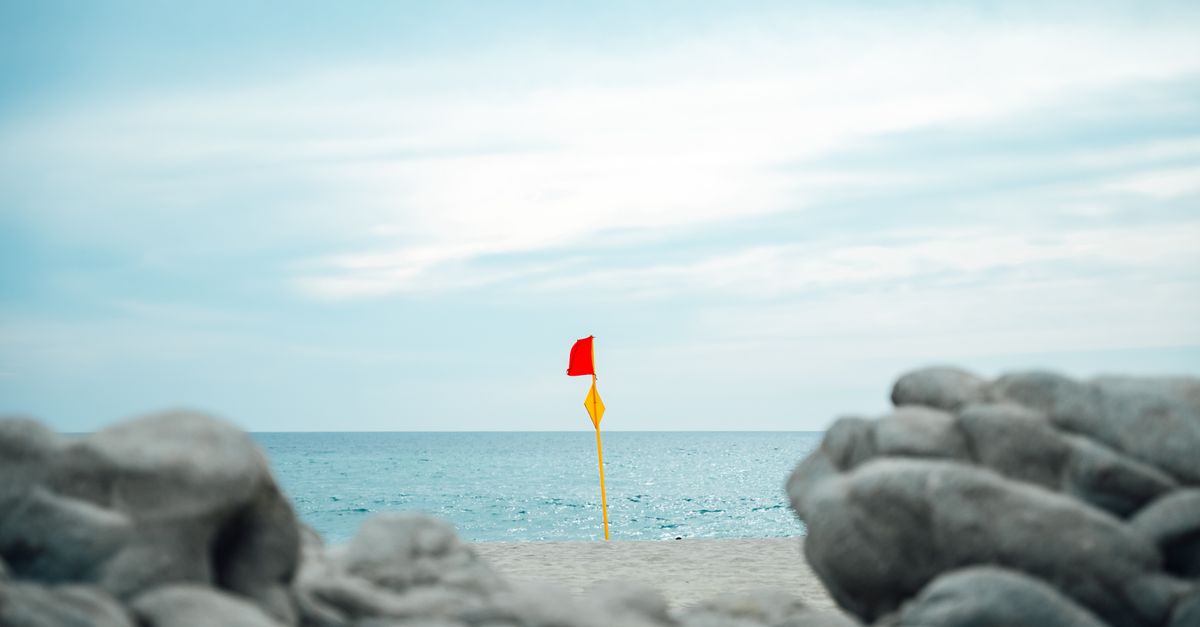
Amelia Island's beaches use Florida's statewide beach warning flags, and the color can change more than once in a day. Check before you leave the house: text BCHSAFE to 888777, open the city's public safety dashboard, or call Ocean Rescue at (904) 310-3152. Green is low hazard, yellow medium, red high, purple stinging marine life, two reds closed water.
The flags are small colored rectangles on the towers and at the walkovers, and most people give them the attention they give a parking sign. They are worth thirty seconds. Florida uses one flag vocabulary from the Panhandle to the Keys, so learning it once tells you what the ocean is doing at any beach in the state, including the one at the end of your street.
What color is the flag at the beach?
Today's flag is one of Florida's five state warning flags: green for low hazard, yellow for medium, red for high, purple for stinging marine life, and red with a white no-swim graphic for water closed to the public. The flags come from a statewide program the Department of Environmental Protection runs under Section 380.276, Florida Statutes. Read the statute closely and it does not order every beach to fly anything. It says that where flags are displayed, "only warning and safety flags developed by the department shall be displayed," and it opens participation to any government with a public beach, whether or not that beach has lifeguards. To the extent funds are available, the state supplies the flags and the interpretive signs free of charge to local governments that provide public beach access, which is why the flag at Peter's Point carries the same meaning as one flying in Destin.
The state set is five flags in four colors; the fifth is a red flag carrying a white no-swim graphic. This is the wording on Florida's own interpretive sign:
| Flag | What it means |
|---|---|
| Red with white no-swim graphic | Water Closed to Public |
| Red | High Hazard: high surf and/or strong currents |
| Yellow | Medium Hazard: moderate surf and/or currents |
| Green | Low Hazard: calm conditions, exercise caution |
| Purple | Stinging Marine Life: Man o' War, Jellyfish, Stingrays |
Read the purple row twice. It is a jellyfish and man o' war warning, not a shark warning, and beachgoers reverse those two constantly.
Locally you will also see two red flags flown together. When Fernandina Beach Ocean Rescue put out its flag reminder during Nassau County's 2025 Beach Safety Week, it listed double red as water closed to the public, alongside red for dangerous conditions and high surf, yellow for medium hazard, and purple for stinging marine life. Two reds up means stay out.
Here is the part the color chart leaves out. The flags give general warnings about overall surf conditions and do not specifically advise the public of the presence of rip currents, which is why the state also distributes separate rip current educational signs when funds allow. A yellow flag on a calm-looking morning is not telling you the rips are mild. It is telling you the overall surf hazard is moderate. Rip current risk is a separate reading, and it comes from the weather service rather than the flagpole.
What does it mean if there is no flag on the beach?
No flag means no information, not a green flag: Nassau County states plainly on its own beach page that not all beaches have flags posted, and the absence of flags does not indicate safe waters. Florida's own interpretive sign carries the same warning along its bottom edge: "Absence of Flags Does Not Assure Safe Waters." On a thirteen-mile island with a long run of quiet accesses between the guarded parks, that matters more here than it would on a short municipal strand. If you park at an unstaffed walkover and see no pole, you have no information. Get it before you get in.
How do you spot a rip current before you get in the water?
Look for discoloration in the water and for waves that break oddly and foam heavily, and read the surf from the top of the dune crossover, the only elevation you get. Those are the signs the Fernandina Beach Ocean Rescue supervisor named after his crew pulled a 17-year-old out of a rip current at Peter's Point in April 2019.
"To identify rip currents, if there's discoloration in the water or if there's waves that are breaking funny, they're not breaking regular, very foamy – we want to stay away from that area," said Haynes Cavender, now the city's Ocean Rescue Division Chief, speaking to Action News Jax.
Red flags had flown all that weekend. The same report noted that lifeguards urge families not to go in past their knees when rip currents are present — a plainer rule than most swimmers apply to themselves.
If a rip does take you, do not fight it. NOAA's advice is to swim parallel to the shore and swim back to land at an angle. The same page notes that rip currents move at speeds of up to eight feet per second, faster than an Olympic swimmer, and that panicked swimmers who try to head straight back to shore put themselves at risk of drowning from fatigue.
Where and when are lifeguards on duty on Amelia Island?
Lifeguards watch six beaches — North End Park, Main Beach, Seaside Park, Peter's Point, Scott Road, and Burney Park — on weekends from the first weekend of May and daily from Memorial Day through Labor Day. The guarded locations are staffed 11 a.m. to 5 p.m. on weekdays and 10 a.m. to 5 p.m. on weekends and holidays. Fernandina Beach Ocean Rescue is a division of the city fire department, and it provides technical water rescue and lifeguard services to all thirteen miles of Amelia Island's beaches and surrounding inland waterways. The city puts its seasonal roster at approximately 60 certified ocean lifeguards from May to September; Nassau County's page puts it at approximately 40.
Read those hours against how people actually use the beach. The long golden stretch after five o'clock, when the crowd thins and the light gets good, is unguarded. So is every sunrise swim. For rip current or shark activity updates you can also call Nassau County Beach Safety at 904-277-7331.
The National Weather Service office in Jacksonville publishes a daily surf zone forecast that names the beaches of Yulee and Fernandina Beach, and it grades rip current risk in three tiers. Low means the risk is low, though life-threatening rip currents often occur in the vicinity of groins, jetties, reefs, and piers. Moderate means life-threatening rip currents are possible in the surf zone. High means they are likely. Moderate is not a mild word in that vocabulary.
How dangerous are rip currents?
NOAA estimates that 100 people are killed by rip currents annually in the United States, while lifeguards rescue tens of thousands more. The weather service also keeps a running surf zone fatality tracker; checked on September 7, 2026, its headline count for the year read 49. The tracker labels its own data preliminary and its locations approximate, so read it as a shape rather than a scoreboard.
Summer is when the water here is warmest and the beach is fullest. That overlap is the whole argument for the thirty-second flag check.
What do beach flags have to do with living on the island?
Beach flags are the quickest free lesson in how the water here behaves, and the residents who get the most out of living on the island are the ones who learn its habits. People buy on a barrier island for the water, then treat the water as scenery. The ones who learn it know which accesses hold parking after ten on a Saturday, which walkover gives the best read on the water, how the surf changes between the north end and the quieter southern stretches. The flag on the tower is that education in its shortest form, posted daily.
If you are weighing a home near one of these accesses, that is worth understanding before you choose a street. The beach at North End Park and the beach at Burney Park are not the same beach, and neither is the day you will have at each. I am happy to walk that comparison with you, access by access, so the coast you buy is the coast you actually want.
Check the flag. Then go enjoy the ocean it is describing.
Love Where You Live.
Frequently asked questions
Where can I check beach flags?
Text BCHSAFE to 888777 for daily surf condition alerts from Nassau County, open the Safe Beach Day dashboard the city's Ocean Rescue page links to for conditions and guard tower staffing, or call Fernandina Beach Ocean Rescue at (904) 310-3152. Nassau County Beach Safety answers rip current and shark questions at 904-277-7331.
What do the beach flag colors mean in Florida?
Florida's interpretive sign shows five flags in four colors: a red flag with a white no-swim graphic means water closed to the public, red means high hazard with high surf and/or strong currents, yellow means medium hazard with moderate surf and/or currents, green means low hazard and calm conditions, and purple means stinging marine life — man o' war, jellyfish and stingrays, not sharks. Fernandina Beach Ocean Rescue also lists double red as water closed to the public.
Does Florida law require every beach to fly a warning flag?
No. Section 380.276, Florida Statutes, directs the Department of Environmental Protection to encourage the display of uniform flags, and it says that only flags developed by the department may be displayed. It does not require a beach to fly one, which is why an empty pole is not a statement about the water.
Are lifeguards on duty at Amelia Island beaches?
Seasonally. Guards work weekends starting the first weekend of May and daily from Memorial Day through Labor Day, 11 a.m. to 5 p.m. on weekdays and 10 a.m. to 5 p.m. on weekends and holidays, at North End Park, Main Beach, Seaside Park, Peter's Point, Scott Road, and Burney Park. Evenings after five and every sunrise swim are unguarded.
Does no flag flying mean the water is safe?
No. Nassau County states that not all beaches have flags posted and that the absence of flags does not indicate safe waters, and Florida's own interpretive sign carries the same line. Check a text alert, the dashboard, or call Ocean Rescue before entering the water at an unguarded access.
What are the current ocean conditions on Amelia Island?
Conditions change through the day, so check a live source: text BCHSAFE to 888777 for Nassau County's daily surf alert, open the Safe Beach Day dashboard for hazards and guard tower staffing, or read the National Weather Service Jacksonville surf zone forecast, which grades rip current risk Low, Moderate, or High for the beaches of Fernandina Beach and Yulee. The flag reports overall surf hazard; rip current risk is a separate reading that comes from the weather service rather than the flagpole.
What does a purple flag mean at the beach?
Purple means stinging marine life — man o' war, jellyfish and stingrays. It is not a shark warning, though beachgoers reverse those two constantly.
Sources reviewed
- NOAA Ocean Service — rip current facts
- National Weather Service — Surf Zone (Rip Current) Fatalities tracker
- NWS Jacksonville — Surf Zone Forecast (SRF) product
- Florida Department of Environmental Protection — Beach Warning Flag Program
- Volusia County, FL — official Beach Warning Flags page
- Nassau County, FL — official Beach and Water Activities page
- Nassau County, FL — official Beach Safety page
- City of Fernandina Beach, FL Fire Department — Ocean Rescue page
- Safe Beach Day — Fernandina/Nassau beaches dashboard
- The County Insider (Nassau County, FL official communications) — Beach Flag System and Water Conditions
- Action News Jax — Fernandina Beach lifeguards, firefighters rescue teen from rip current
- City of Fernandina Beach staff directory — Haynes Cavender
- Florida DEP - Beach Warning Flag interpretive sign (Beach-Warning-Flag-2024.pdf)