
Alcohol is banned at Egans Creek Greenway, a city-run park whose rules prohibit motorized vehicles, fireworks, alcohol, hazardous materials, and fires. Nassau County's beach ordinance also prohibits sealed and open alcoholic beverages on its unincorporated beaches and in beach parking areas. The city's public beach accesses close nightly from midnight to 5 a.m.
The confusion around this question is earned.
The sand and the parks behind it are not all managed by the same office. The city publishes rules for its own parks. The county's rules cover its own recreation areas. Walk far enough in either direction and the ground under your towel changes hands without announcing it, which is how one simple question ends up with two confident answers.
Can you drink alcohol on the beach?
Plan on no.
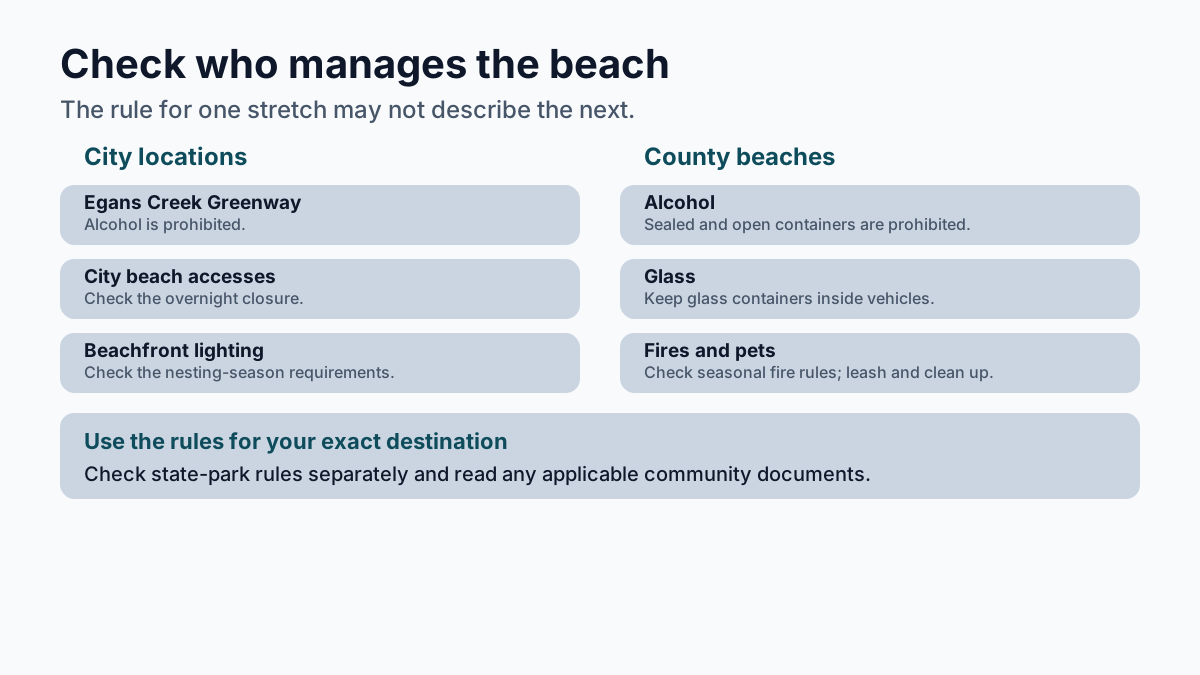
For the island's beaches and beach accesses, start by checking who manages your stretch. Nassau County's ordinance prohibits possessing sealed or open alcoholic beverages and drinking alcohol on its unincorporated beaches and in beach parking areas. Section 23½-15 lists a $500 fine and/or sixty days in county jail, along with an order to leave and possible vehicle towing.
Where that wording lives matters. It comes from Nassau County's own ordinance, which the county links from its current beach information page. That is a county beach rule, not a substitute for checking the city's rules or the rules for a state park. Every rule below that carries a city link comes from the city's own pages.
What all of it means on a Saturday is simple. The cooler comes down to the sand. The alcohol stays at the house.
Where is the alcohol ban written in black and white?
Egans Creek Greenway is the clearest case, because the body that manages the park publishes the rules for it. No motorized vehicles, fireworks, alcohol, hazardous materials, or fires. Five items, one sentence, no interpretation required.
That's the standard worth holding any local rule to. When the owner of the ground states it in its own words, you can stop guessing.
Which other beach rules should you check?
Alcohol gets the attention, but access hours, glass, fires, and pets are worth checking too. These are the questions that can change an afternoon.
- The city's beach accesses are closed from midnight to 5 a.m. every night.
- On the county's unincorporated beaches and in its beach parking areas, glass containers are prohibited outside a vehicle.
- The county prohibits beach fires from May 1 to October 31.
- On county beaches, dogs must stay leashed and owners must remove their waste.
Those fire dates match the city's official sea turtle nesting season, May 1 through October 31, when the city conducts beach-area lighting inspections. Outside that window, the county still regulates where and how a beach fire can be made. Check the rules for the exact beach before planning one.
What does one July evening look like when you plan around these rules?
A July evening under these rules means a soft cooler of water and alcohol-free cans, the dog on a leash, no fire on the sand, and the beer waiting on the porch. Say you're renting three streets back from the dune line for a week in July.
You cross the boardwalk at four with a soft cooler of water and cans of something without alcohol, because the county's alcohol restriction covers sealed containers too. The dog comes, on a leash. Nobody's building a fire, because it's July and the nesting-season ban is on. At seven you fold the chairs and walk back, and the beer you were thinking about gets opened on the porch instead, which is where the evening was going anyway. If you come back down after dinner, you do it before midnight, if you're using a city access, because those close then and don't reopen until five.
Nothing about that day was ruined by a rule. It just moved one drink from the sand to a porch.
What do these rules tell you about a house before you buy it?
These rules give you questions to ask about a house: which lighting requirements apply, what time the nearest beach access closes, and what the community's own documents say. My husband Jim and I bought our Amelia Island house as a second home, expecting to move down about five years later. We were living in Fernandina Beach within the year.
Plans compress. And rules that read like trivia to a visitor become weekly logistics for a resident.
A couple of them show up in real decisions about a property.
For a beachfront house within the city limits, May 1 through October 31 is the city's nesting-season lighting inspection window. Exterior lighting on a beachfront home is therefore a seasonal question, not a decorating one, and it's worth asking about before you commit to a house whose whole back wall faces the water.
A city beach access also has a quiet window built into it, because it closes at midnight and stays closed until five. If you're comparing two streets and one of them dead-ends at an access, that closure is part of what you're buying.
Then there is the layer underneath. Ask for a private community's governing documents and read its rules alongside the public ones. Don't assume the public rule answers every question about the property.
When I walk beachside streets with a buyer, this is the part of the tour that never appears in a listing. Which access is closest and what time it closes. Whose ground the sand in front of the house actually is.
What kind of place do these rules describe?
Read as a set, the rules describe a place that protects its nesting turtles, keeps glass off a barefoot beach, and closes its accesses overnight. On county beaches, fires are restricted during nesting season and glass containers stay inside vehicles. Alcohol is out where the county controls the ground. The accesses close overnight, which is the closest thing a beach town has to a curfew for its own shoreline.
None of that is decoration. It's a barrier island doing maintenance on itself, in public, with dates attached.
Some places hand you a list of what you can't do. The better ones are telling you exactly what they're trying to keep.
If you are considering a move to Amelia Island, I would be happy to help you compare the beachside streets and the neighborhoods behind them, including how each one actually lives from May through October.
Frequently asked questions
Can you drink alcohol on Amelia Island beaches?
Plan on leaving alcohol at home. Nassau County's ordinance prohibits drinking and possessing sealed or open alcoholic beverages on its unincorporated beaches and in beach parking areas. Its listed penalty is a $500 fine and/or sixty days in county jail, with removal and vehicle towing also addressed. Check the rules for the exact city, county, or state-park beach you plan to use.
Is it legal to bring an open container of alcohol on Fernandina Beach?
Leave it at home. The county beach ordinance prohibits both sealed and open alcoholic beverages on unincorporated beaches and in beach parking areas. Egans Creek Greenway separately bans alcohol under the city's park rules. Check the city directly for the rules on a beach within its limits.
Can you have a fire or glass bottles on the beach?
On Nassau County's unincorporated beaches and in beach parking areas, glass containers are prohibited outside a vehicle. County beach fires are prohibited from May 1 to October 31 and remain regulated outside those dates. Check city or state-park rules separately for a beach under their management.
Are alcoholic drinks allowed on beaches in Florida?
Check the authority responsible for the specific beach. On Nassau County's unincorporated beaches, the county ordinance prohibits drinking and possessing sealed or open alcoholic beverages. Do not assume that one beach's rules describe every Florida beach.
Sources reviewed
- City of Fernandina Beach — Egans Creek Greenway Rules
- City of Fernandina Beach — Beach Accesses (official site)
- City of Fernandina Beach — Sea Turtle Lighting and Beach-Friendly Tips
- Nassau County Ordinance2025-037 §23½-15 alcohol
- Nassau County Ordinance2025-037 §23½-16 glass
- Nassau County Ordinance2025-037 §23½-14 fires
- Nassau County Ordinance2025-037 §23½-22 dogs
- Angie's own published relocation account